


Umbria
Travel Guide
Everything you need to know
Where is Umbria
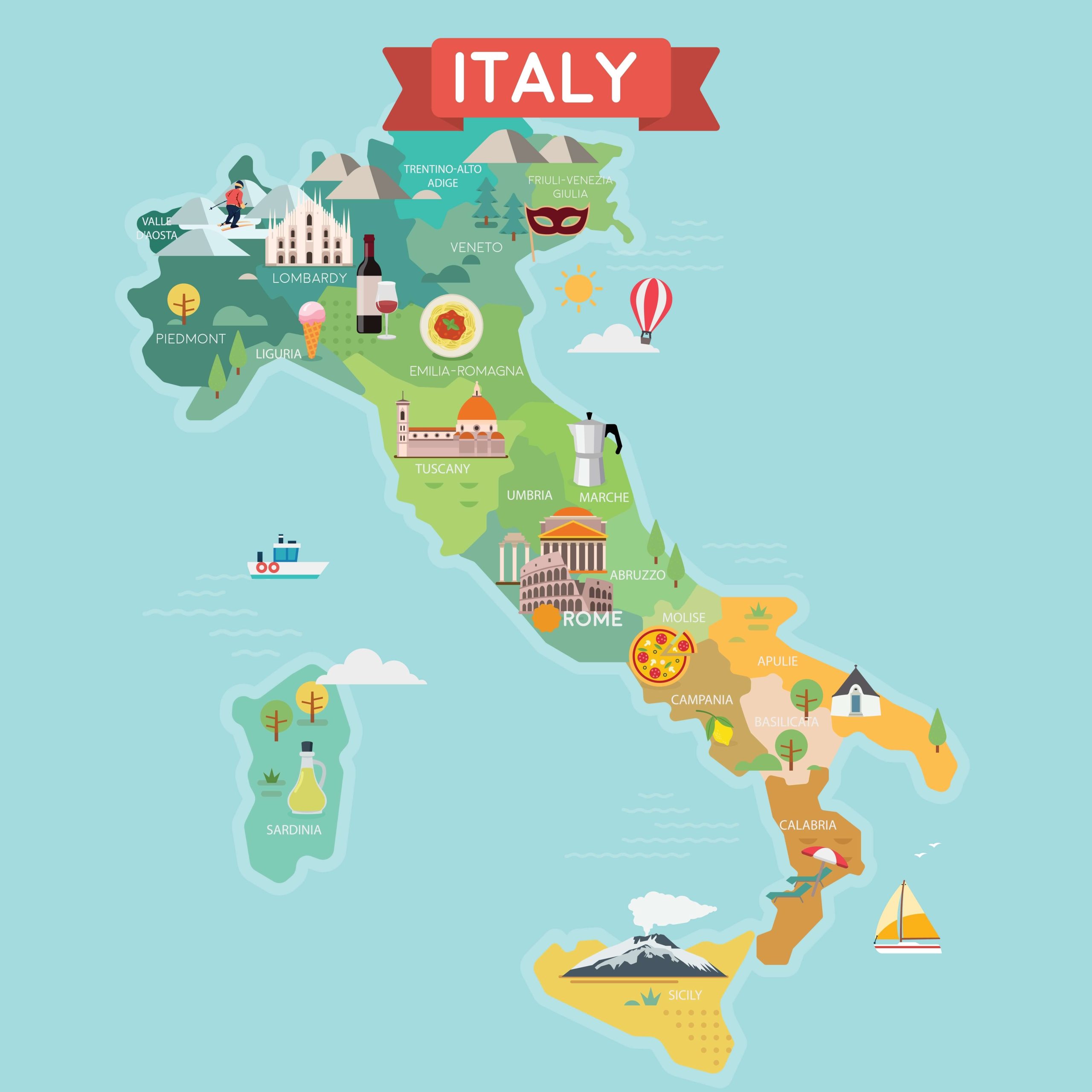
Nestled in the centre of Italy, south east of Tuscany, north of Rome and Lazio, and west of Marche, Umbria is affectionately referred to as Italy’s ‘green heart’. It can claim to be the only Italian region that does not border either the sea or a neighbouring country. As one of Italy’s smaller regions it has just two provinces: Perugia to the north and Terni in the south.
The city of Perugia is the capital of Umbria. Other principal cities include Assisi, Orvieto and Spoleto. Compared to its more famous neighbours, Umbria has traditionally remained somewhat under the radar. This has ensured that it has remained authentic, seemingly untouched by time.
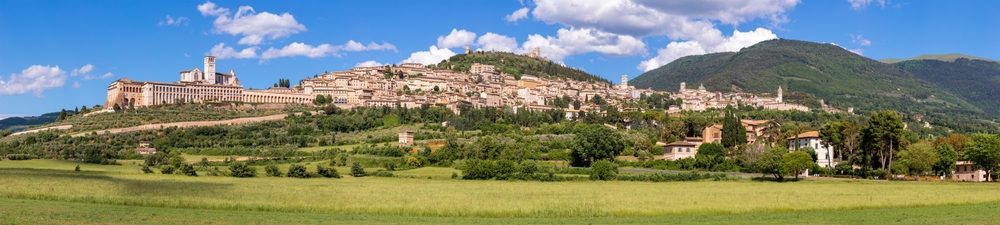
Umbria is best known for its idyllic Medieval hilltop villages and rural landscapes. Wooded hillsides, fertile valleys, olive groves and vineyards dominate the landscape. In short, Umbria is the perfect Italian holiday destination if you’re in search of a less crowded Italian experience.
How to get there
Umbria is very easy to reach either using public transport or by car. It is a very competitive route meaning that travel costs don’t need to break the bank either.
By Plane
Umbria does have its own airport – San Francesco d’Assisi airport (PEG) which is located in Perugia. However, many airlines only operate in and out of the airport between April and October, meaning alternatives need to be sought in the Winter months. Perugia airport also only offers short haul flights, so even in peak Summer months it is worth considering alternatives nearby. That said, if you can fly into Perugia, it is a wonderfully small airport typically meaning less queuing than the larger alternatives. Rome, Florence, Pisa and Ancona airports are all easily accessible and, if you don’t mind a slightly longer transfer time, then Genoa and Bologna are also options.
By Train
Whilst it is possible to reach Umbria by train, the region is not served by Italy’s high speed train network. If you’re travelling from Rome city centre, there are direct trains to Orvieto and Spoleto which take 75 and 105 minutes respectively. Or, from Rome to Foligno, it’s about 2 hours by train. If you’re looking to get to the Umbrian towns of Spello or Perugia, you will need to change trains here. Alternatively, if flying into Rome airport, then you can take the Leonardo Express into the centre of the city and then connect from here to Perugia.
If coming to Umbria from Florence, there are direct trains from Florence to Perugia. The journey time is approximately 2 hours. Or you can also catch a direct train from Florence to Orvieto (2.5 hours).
All trains are operated by Trenitalia. Find out all train times, prices and book tickets at Trainline. Or find out more about train travel in our handy guide to travelling by train in Italy.
By Car
If you are driving to Umbria from outside Italy, then there are three main points of entry into the country by car – the Mont Blanc tunnel from France, the Grand Saint Bernard tunnel from Switzerland and the Brenner Pass from Austria.
Once across the border in Italy, the country has a good road network. If you’re looking to get from A to B quickly, then it’s worth using the Italian Autostrada. These are fast roads requiring payment to use them. Toll booths will either require immediate payment or ask you to take a ticket, in which case payment will be made when you exit the motorway.
The A1 Autostrada (nicknamed the Autostrada del Sole) is the motorway which leads from the north to the south of Italy, linking Milan to Bologna, Florence, Rome and Naples. This runs along the western border of Umbria. From Rome to Orvieto, the drive is about 90 minutes, traffic permitting. Or Florence to Perugia is approximately 2 hours. Alternatively, if you’re coming from Siena, take the Raccordo Strada from here to Perugia. The journey should take around 1 hour and 20 minutes.
Since much of the region of Umbria is rural, even if you are arriving by plane, we do recommend you hire a car.
By Bus
Sulga Autolinee connects Italy’s major cities – Rome, Florence, Naples and Milan – with a number of towns in Umbria including Todi, Assisi and Gubbio. As is the case in most of Europe, Flixbus also offers coach travel to Umbria, with direct services from Rome, Bologna and Florence.
How to get around Umbria
Once you have arrived in Umbria, you have a few options about how to get about during your holiday. We do usually recommend hiring a car – even if you don’t use it every day, it will give you so much more freedom and allow you to explore parts of Umbria that may be hard to reach using public transport. However, it’s good to understand all the options open to you.
Public Transport
Whilst we’re big fans of train travel at Bookings For You, travelling by train in Umbria is arguably not quite as easy as in some other Italian regions. Most of Umbria’s towns are not connected with larger cities (as Tuscan towns would be to Pisa or Florence for example). As a result, you need to be prepared for one or even two train changes to get from A to B.
The other key factor is that many of Umbria’s towns are medieval hilltop towns. Whilst they may have a train station, it is often not in the heart of the town but instead a short drive away, more often in a more modern, functional outcrop. That said, don’t let this put you off. If you do find that the train station is located away from the town itself, you don’t need to worry. You can typically hop on a bus to get you from the station to the centre. Bus timetables usually correspond with incoming trains. Or, in some cases, if the train station is at the base of the hillside, there are funiculars or escalators which can help make the journey to the town centre more efficient.
Just be aware that both the train and bus service tends to be more infrequent at weekends and on public holidays. Umbria hosts a wonderful calendar of feasts and festivals and these very often do impact public transport schedules so check before you travel. On the plus side, if you can master the train routes, then the journey will often be spectacularly beautiful. But just be prepared to spend a little bit more time planning your journey.
Use the Umbria Mobilita website or Trainline to check train times in Umbria. These should show both regional and national trains, whereas the Trenitalia website that we normally recommend may not.
Alternatively, travelling by bus in Umbria is a great way to experience the region at a slower pace and reach towns and villages that sit beyond the main train routes. You can often find that, even when there are train links between Umbrian towns, the bus offers a faster solution. Almost every town has some form of bus connection, making it possible to explore even smaller destinations, although services in more rural areas can be infrequent, particularly on weekends and on public holidays. Planning ahead is essential, but travelling by bus remains one of the most budget-friendly ways to get around Umbria.
Italy does not have a single national bus network, and Umbria is no exception. Bus services are regionally operated and in some cases multiple companies run routes within the same area. While this can feel a little confusing at first, timetables are generally reliable once you know which operator you need.
The main public transport provider in Umbria is Busitalia Umbria, which operates local and regional routes connecting major towns such as Perugia, Assisi, Spoleto, Foligno, Todi and Orvieto, as well as smaller villages. Timetables can be checked online, and the Busitalia app is useful for planning journeys and purchasing tickets in advance. In Umbria this app is called Salgo and is worth downloading in advance to become familiar with it.
In larger towns and cities, local services are usually more frequent. Perugia, in particular, has a well-developed urban network, making it easy to move between the train station, historic centre and surrounding areas. However, once you move into smaller towns or countryside locations, it’s worth allowing extra time and checking return services carefully.
Renting a car and driving
There are many advantages to renting a car in Umbria, not least the freedom it gives you to explore the region entirely at your own pace. While trains and buses connect the main towns, a car allows you to reach Umbria’s smaller hilltop villages and to explore deep into the countryside that may otherwise be difficult to access. We love driving in Umbria – expect winding roads, olive groves, vineyards and sweeping views at almost every turn.
Car rental in Umbria is straightforward. Perugia Airport is served by both international and local rental companies. However, as it’s a bigger airport, many travellers also choose to collect a car from Rome and drive into the region. The journey from Rome to Umbria is relatively simple and well signposted, making it an easy starting point for a road trip.
Umbria has several types of roads, including motorways (autostrade), state roads (superstrade), regional and provincial roads, and strade comunali. In rural areas, you may also encounter strade bianche – white gravel roads commonly found in the countryside. It’s not unusual for the final stretch to your Umbria villa to be along one of these unpaved roads, which are usually well maintained but require slower driving.
The main motorway linking Umbria with Rome is the A1 Autostrada del Sole, which provides fast access to towns such as Orvieto and the western side of the region. Regional roads connect Perugia with Assisi, Spoleto and Foligno efficiently. However, while these main routes are useful for covering distance, we don’t always recommend sticking to them.
Much of Umbria’s charm lies away from the fastest roads which transport tourists functionally between one big city to the next. Provincial and rural routes may take longer, but they lead through some of the region’s most beautiful scenery. These slower roads are ideal if you have the flexibility to enjoy the journey rather than rush to the destination.
There are, however, a few things to be aware of when driving in Umbria. The region is largely rural, and it’s common to encounter slow-moving agricultural vehicles or tractors on narrow roads. And like all of rural Italy you will almost certainly encounter an Ape – Italy’s smallest utility vehicle affectionately named ape (bee) after the noise the vehicles make as they zip up and down the country lanes. Overtaking isn’t always possible, so it’s best to relax, slow down and enjoy the view.
When visiting Umbria’s towns and cities, drivers should also be mindful of Zona the Traffico Limitato (ZTL) areas, which are common in Umbria’s historic centres. Towns such as Perugia, Assisi, Spoleto, Orvieto, Gubbio and Todi all have restricted traffic zones designed to reduce congestion and protect historic streets. ZTLs operate during specific hours, which are clearly displayed on signs, although timings can change and some signs are digital.
Every ZTL entrance is marked by a white circle with a red border and clear signage stating Zona a Traffico Limitato. Rental cars do not have permission to enter these areas unless your accommodation is inside the ZTL and has registered your licence plate in advance. ZTLs are monitored by cameras, and fines can be issued automatically – sometimes multiple times – making accidental entry an expensive mistake. Don’t rely solely on GPS systems, as they don’t always warn you about restricted zones.
By Bike
Cycling tourism is one of the fastest growing industries in Umbria. This is perhaps thanks to the Giro D’Italia which often criss-crosses the region, with some of the most demanding stages taking riders up to Umbria’s magical hilltop towns and cities.
Much of Umbria is defined by rolling hills and open countryside making it a wonderful region to explore on two wheels. With quiet roads, clean air and relatively little traffic, cycling in Umbria’s countryside feels refreshingly unspoilt. The variety of terrain means that whether you prefer gentle rides or stamina testing climbs, there’s something here for everyone.
For riders seeking a challenge, the Apennine foothills and mountain routes provide some of Umbria’s most rewarding cycling. Climbs around areas such as the Monti Sibillini National Park and the roads leading up to hill towns like Gubbio, Spoleto and Assisi are long and sustained, with gradients that demand effort and endurance. The reward is spectacular scenery and descents that make the climb worthwhile. While in the mountains, as with any higher-altitude riding, it’s wise to carry extra layers, as temperatures can change quickly even in summer.
If you prefer a more relaxed ride, Umbria also offers gentler routes through valleys and countryside, particularly around Lake Trasimeno and the central Umbrian plains. These areas are ideal for leisure cyclists, offering flatter terrain, scenic views and the chance to pass through small villages, vineyards and olive groves. E-bikes are widely available and make it easier to enjoy the region’s beauty without tackling every climb head-on.
For off-road enthusiasts, Umbria’s gravel tracks, forest paths and rural lanes are perfect for gravel and mountain biking. These routes often follow ancient paths and quiet farm roads, delivering a more immersive experience of the countryside far from traffic and crowds.
Cities and Towns in Umbria
Unlike in neighbouring Tuscany where city skylines are instantly recognisable, Umbria’s towns and cities are celebrated instead for their understated beauty and rich historical character. Instead of grand skylines, you’ll fine medieval walls and a strong sense of tradition and continuity with the past.
Assisi
Introduction to Assisi
As the birthplace of St Francis, Assisi is world-renowned for being the central stop on the Via di Francesco Camino from Florence to Rome. Saint Francis remains a patron saint of Italy and in 2000, UNESCO designated the Franciscan structures of Assisi as a World Heritage Site.
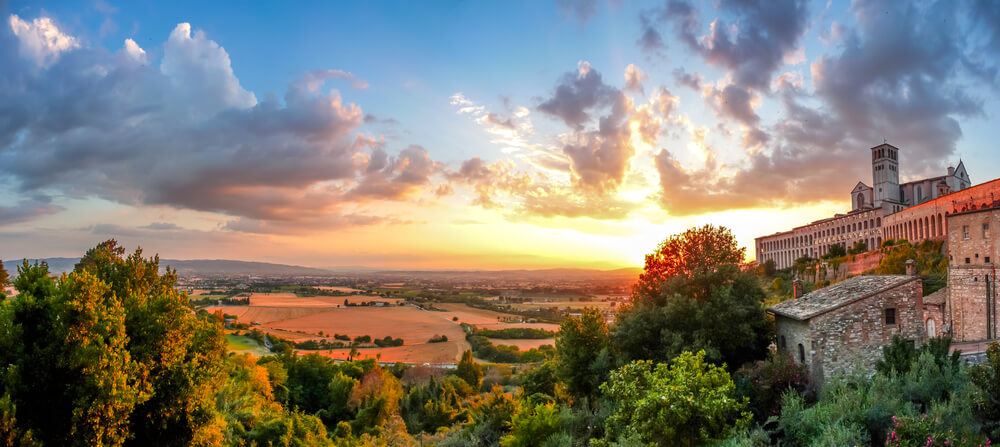
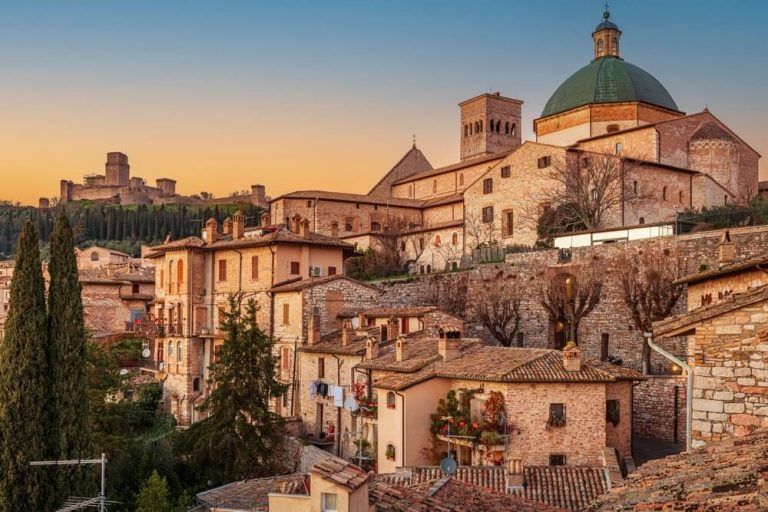
Set high on the slopes of Monte Subasio, Assisi is timeless and there’s nothing like gazing at its pale stone buildings glowing softly in the changing light. Best known as the birthplace of Saint Francis, Assisi blends deep religious significance with medieval charm, creating an atmosphere that is both contemplative and welcoming. Its historic centre, largely unchanged for centuries, invites visitors to slow down and experience Umbria at its best.
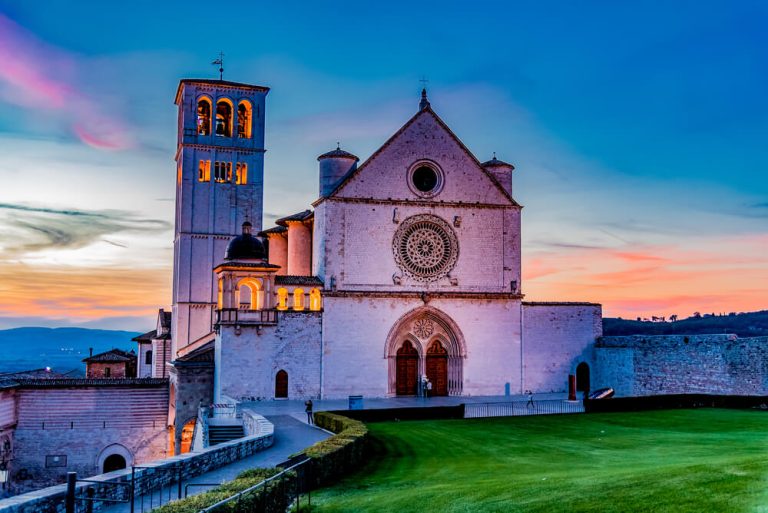
However, when we think of Assisi, we think of one thing above all else: Saint Francis. Pilgrims from all over the world are drawn here to visit the Basilica di San Francesco, one of Italy’s most important religious monuments. The basilica is divided into two levels, both lavishly decorated with fresco cycles that include works attributed to Giotto which vividly depicts the life of the saint.
Beyond Saint Francis, Assisi is also closely associated with Saint Clare, another key figure in the city’s spiritual history. The Basilica of Santa Chiara houses her tomb and offers sweeping views across the lush valley below. Unsurprisingly, throughout the year, Assisi hosts religious celebrations, processions and feast days that gently animate the streets while preserving the town’s peaceful character.
History lovers should also take time to explore the Rocca Maggiore, the imposing fortress that overlooks Assisi from above. The climb is well worth the effort, rewarding visitors with panoramic views across Umbria’s rolling countryside.
Tips for navigating the city
Assuming that you’ll spend most of your time in the historic centre, Assisi is small enough to explore almost entirely on foot. The town’s streets wind gently up and down the hillside, passing through picturesque medieval archways and quiet piazzas. Be aware that while Assisi is less sprawling than some Umbrian hilltop towns, its lanes are often sloped, uneven and cobbled, so comfortable, supportive footwear is strongly recommended.
If you’re arriving by train, Assisi station is located in the lower town of Santa Maria degli Angeli. From here, frequent local buses make the uphill journey to the historic centre. These are easy to navigate and will drop you near the main entrances to the old town. Taxis are also readily available and are a good option if you’re travelling with luggage or prefer a quicker ascent.
Within the historic centre itself, walking is by far the best way to get around. Most major sights, including the Basilica of San Francesco, Piazza del Comune and the Basilica of Santa Chiara, are connected by pedestrian-friendly routes. While there are occasional short but steep climbs between landmarks, the town’s compact layout means you’re never far from your next stop or a café where you can pause for refreshment and take in the view.
If you choose to drive to Assisi, it’s important to be mindful of the ZTL (limited traffic zones), which are strictly enforced. Parking is available in several pay and display car parks just outside the historic centre, such as those near Piazza Matteotti or Porta Nuova. From here, you can walk or use short shuttle connections into town. As always, it’s wise to check parking availability and any temporary restrictions in advance, particularly during religious festivals or peak travel seasons.
Accommodation and dining recommendations
If you plan to stay overnight in Assisi, there are plenty of accommodation options on offer. These include hotels in Assisi, B&Bs as well as a good selection of apartments too. Just be aware that, whatever option you choose, you will need to pay a tourist tax. In Assisi, like everywhere in Italy, the tourist tax applies to all accommodation but the amount due depends on the type and rating of your hotel or holiday rental. Typical costs are between 1.50 and 4 euros per person per night. The tax applies to all visitors aged 14 and over and it is applied for a maximum of four consecutive nights. Alternatively, given how easy it is to reach Assisi by public transport, you could also opt to stay in an Umbria villa in the beautiful surrounding countryside. Villa Assisi is an excellent option. Just 6 kms from the centre of Assisi, it’s the perfect place to use as a base to explore the area.
Like every town or city in Umbria, Assisi offers something for everyone in terms of dining options. For excellent food and top standard service too we love Il Baccanale. Perfect for lunch or dinner, it’s a great place to try some of the finest dishes the region has to offer. Another favourite is Taverna Magna Comunis, perfect for dinner but also a great spot for an evening aperitivo. This is mostly due to the restaurant’s prime position in the Piazza del Commune – one of Assisi’s best people watching spots.
Our favourite option for a coffee or delicious sweet treat is Pasticceria Sensi. The pastries and desserts are really special and worth the wait in the queue which can often be found at this ever popular coffee shop.
Gubbio
Introduction to Gubbio
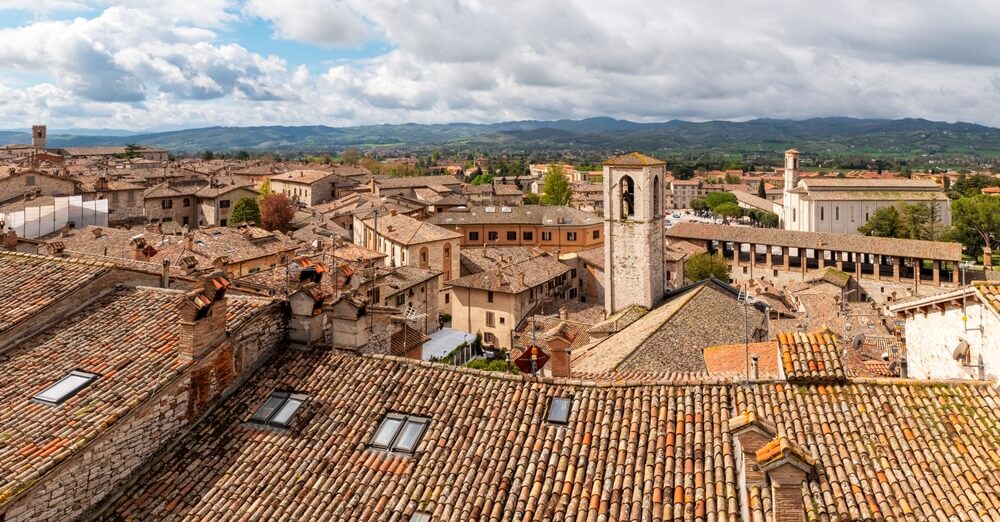
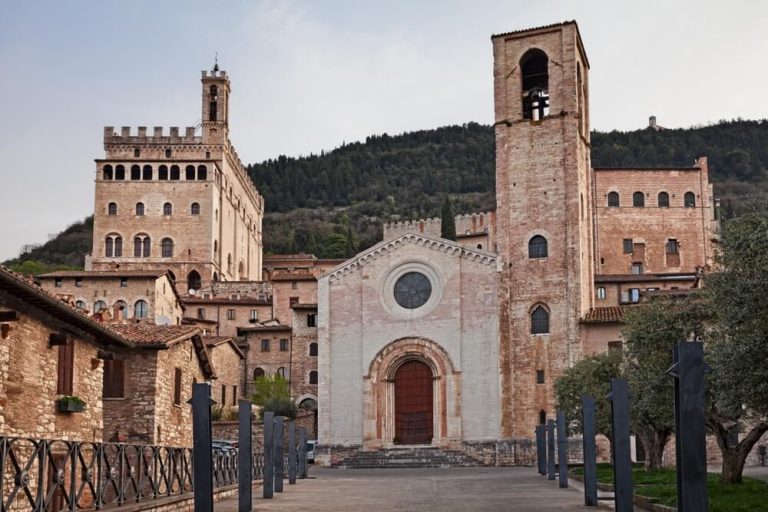
Perched on the slopes of Monte Ingino in northern Umbria, Gubbio is one of the region’s most atmospheric and best preserved medieval towns. Just under an hour’s drive from Perugia, it’s easy to reach yet feels wonderfully removed from the more well known Umbrian tourist hotspots. With magnificent stone buildings, steep winding alleys and dramatic vistas, Gubbio offers travellers a deep sense of history and an unmistakably Umbrian experience.
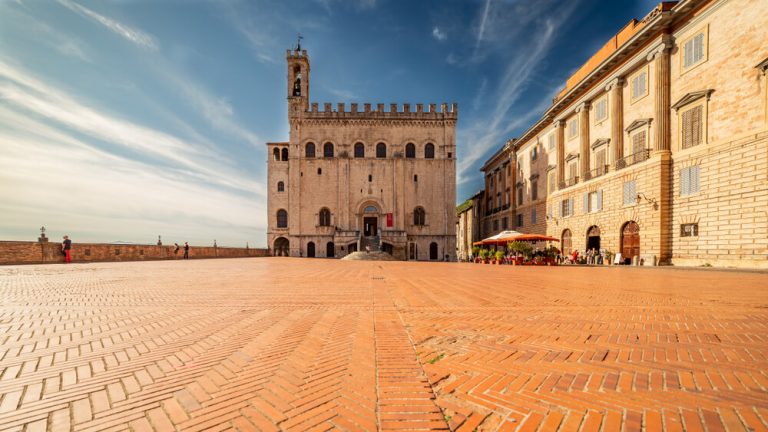
At the heart of the town is Piazza Grande, one of Umbria’s most striking squares, which feels almost suspended above the valley below. This is where you’ll find the Palazzo dei Consoli, Gubbio’s most iconic building and a powerful symbol of the town’s medieval independence. From here, the views across the Umbrian countryside are nothing short of spectacular.
Gubbio is known for its remarkably well preserved medieval centre, where grey limestone palazzi climb the hillside in layered terraces. Walking through the town feels like stepping back in time, with narrow alleyways opening onto grand civic buildings and quiet piazzas. Despite its historical weight, Gubbio has a relaxed, lived-in feel that makes it easy to settle into and explore at an unhurried pace.
Gubbio is also a town of deep rooted traditions, most famously the Corsa dei Ceri, a centuries old festival held each May that brings the entire town together in a powerful display of community spirit. This strong sense of identity is felt year round, giving Gubbio a character that is both authentically local and welcoming to its visitors.
If you have time, make your way up Monte Ingino to visit the Basilica of Sant’Ubaldo, home to the town’s patron saint. Whether you reach it on foot or via the cable car, the journey is rewarded with sweeping views over Gubbio and the beautiful Umbrian landscape beyond. We particularly love it at sunset, when the town below glows softly in the fading light.
And finally, just outside the historic centre lies Gubbio’s Roman Theatre, a remarkably well-preserved site dating back to the 1st century BC. It’s a peaceful spot to visit and offers a fascinating contrast to the medieval town above.
Tips for navigating the city
Gubbio is a fairly small hilltop town and can be explored in a day. All of the main attractions are easily discovered on foot. Simply wandering the alleys and piazzas is the best way to discover the magic of Gubbio. But be prepared for a bit of a workout! The centre is built on a steep gradient and can be physically demanding in places, particularly as you move away from the lower parts of town towards the Piazza Grande and beyond. Gubbio climbs the lower slopes of Monte Ingino, with long inclines, stone staircases and narrow, uneven streets throughout its centre so comfortable walking shoes are essential.
One of the easiest ways to reach the upper part of town, or to head up to the Basilica di Sant’Ubaldo, is via the funivia (cable car). These small, open cages are a uniquely Gubbio experience and make the climb far more manageable while offering wonderful views along the way.
Cycling into Gubbio is possible but only recommended for experienced riders. The climb is long and sustained. As with many Umbrian hill towns, the effort is rewarded once you arrive, but it’s not a route for beginners.
If you’re arriving by car, there are several car parks at the lower edge of the historic centre, making it easier to explore on foot without navigating the narrow streets. Be mindful of the ZTL zones, which are clearly signposted and strictly enforced. During festivals, particularly around the Corsa dei Ceri in May, access and parking restrictions can change, so it’s worth checking local information in advance.
Gubbio does not have a train station but is served by a regular bus service from other towns in Umbria, including Perugia. It is also on the main bus route from Rome to Ancona.
Accommodation and dining recommendations
We love Gubbio, and as fans of authentic Italy, it is one of our favourite towns in Umbria. However, we don’t think it’s necessary to stay in the centre of the town to enjoy all it has to offer. Given that it’s so easy to reach from the surrounding countryside, we recommend finding an Umbria villa rental outside the city. The countryside around Gubbio is nothing short of spectacular. If you’re travelling in the height of the summer, then our advice is to find somewhere with a pool to cool off after a day of sightseeing in Gubbio or its neighbouring hilltop towns. Discover our full collection of Umbria villas and apartments with pools.
At just 10km from the centre of Gubbio, Apartment Allora is the perfect choice. Guests can tuck into a delicious daily breakfast which is included in the rate. And, as part of a small collection of apartments on the same site, it’s ideal if you’re travelling in a larger group of friends or extended family. Discover them all here.
Wherever you decide to stay, dinner in Gubbio – or at least a long lunch – is essential when visiting the area. Taverna del Lupo is a favourite of ours and a true local favourite too. With its rustic interiors and traditional Umbrian menu, it’s a great place to try regional specialities. The portions are generous, the service welcoming, and the experience authentically Gubbio.
For a glass of wine or a light bite be sure to visit Martintempo Lounge Experience. This is a relaxed bar with the perfect balance of sophistication and Umbrian welcome. There is often live music, but the main event here are the cocktails – they are perfetto!
For an unpretentious and delicious gelato, head to La Gelateria on Via della Repubblica. Don’t be fooled by the understated exterior. Inside you’ll find a treasure trove of delicious gelato from traditional chocolate and pistachio to more adventurous creations. They also serve frozen yoghurt, if you fancy a change from gelato.
Orvieto
Introduction to Orvieto
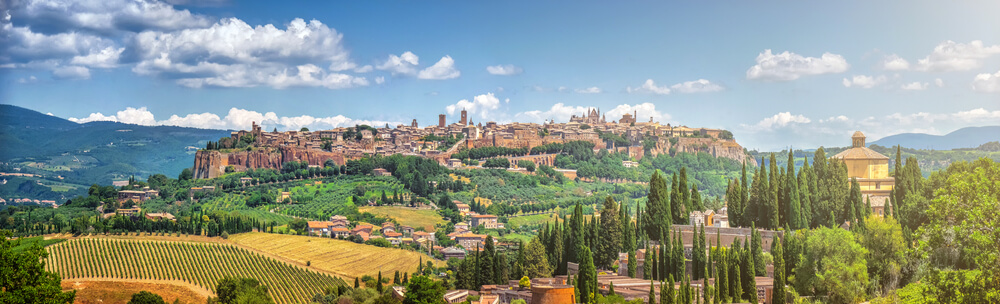
Situated in the province of Terni in the South West of Umbria, Orvieto is one of Umbria’s most beautiful cities. Perched on tufa (limestone) rocks, Orvieto is famous for its wine, umbricelli pasta, black truffles and olive oil, as well as being rich in art and architecture.
Please note: There is a more modern lower part constructed after WWII which doesn’t have the same shine to it so we recommend sticking to this elevated old town.
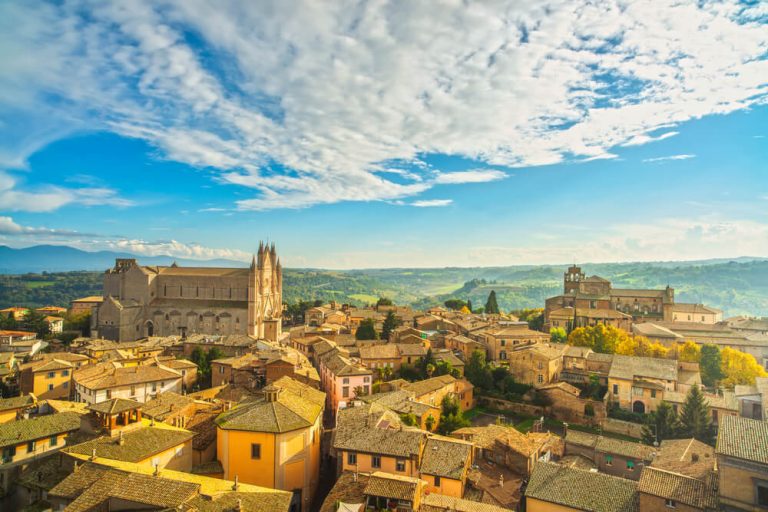
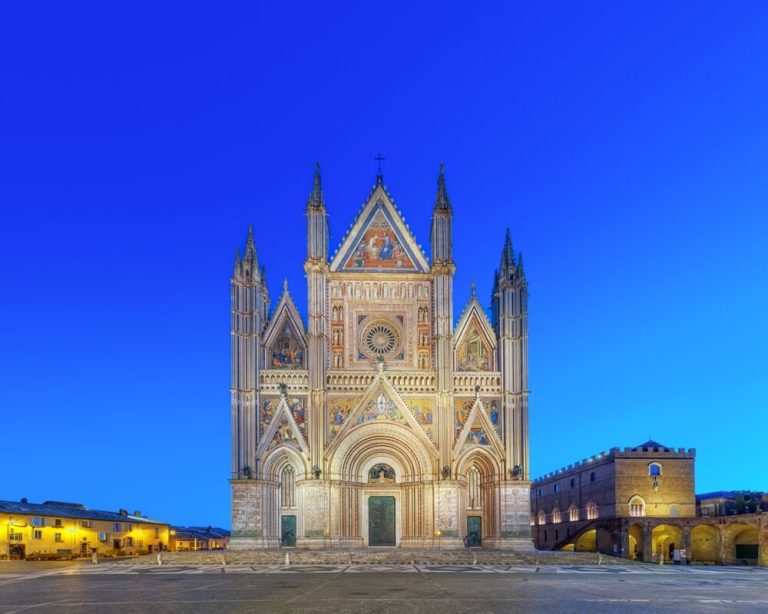
Orvieto is a town where you could lose yourself for hours just exploring its charming streets, browsing the independent shops and admiring its stunning churches and historic palaces. However, Orvieto’s 14th century Duomo is its most famous sight. This impressive spectacle is arguably one of the greatest Gothic buildings in Italy but it does also have Romanesque influences. Its facade is simply stunning. It is decorated with a series of mosaics which tell the story of the Virgin Mary.
Inside the Duomo, there are some beautiful frescoes by Luca Signorelli in the San Brizio Chapel (Cappella di San Brizio) depicting the Last Judgement. There are also some important sculptural masterpieces including the statue of Pietà by Ippolito Scalza, created from a single block of marble, as well as two important statues crafted by Francesco Mochi in the early 600s.
For a completely different perspective on Orvieto, make your way to the Torre del Moro. Visitors can climb its steps to reach a spectacular terrace where you can enjoy 360 views over Orvieto and beyond. Be prepared to take your time as you make your way up though. In total there are 236 steps to climb. There is a lift, but it will only take you part of the way, stopping at the second level and still leaving you with 160 steps left to conquer! The bell at the top rings every 30 minutes.
However, our favourite of Orvieto’s towers is the Torre di Maurizio, with its beautiful clock face. Look to the top of this working medieval tower to find the bell and bronze bell ringer (Maurizio) flanked by a pair of smaller bells, all on stilt-like legs. The clock originally served to provide those working on the construction of the Duomo with the time and it still works perfectly today – sounding every hour on the dot.
Finally, don’t miss out on the opportunity to explore what is right under your feet in Orvieto too. The Grotta della Rupe is a quite extraordinary series of caves, cellars, aqueducts, quarries and tunnels that visitors can enjoy a tour of today. In total over 1200 caves have been discovered and 440 of which can be visited. Some of these date as far back as the Etruscan period.
The history of this network of tunnels is fascinating. A guided tour will give you a glimpse into the varied uses they have had over the years. These include being used as bomb shelters during WWII to being a place to keep pigeons and to press oil in earlier times. Additionally, you must also visit Pozzo della Cava and St Patrick’s Well (Pozzo di San Patrizio). Both are open to visitors. The smaller of the two – the Pozzo della Cava – is a hand dug well, measuring 36 metres deep. Visit at Christmas time and you can witness the annual Nativity in the Well, a charming mechanised nativity scene. St Patrick’s Well measures approximately 175 feet deep and 45 foot wide.
Tips for navigating the city
Orvieto’s historic centre is perfectly self-contained and ideal for exploring on foot. Once you reach the top of the tufa rock on which the city sits, everything of interest – from the Duomo to the quieter backstreets – is within easy walking distance.
Getting up to Orvieto is part of the experience. The funicular railway from Orvieto Scalo (the more modern part of town) makes the ascent effortless and runs regularly throughout the year, connecting the train station with the upper town in just a few minutes. From the top station, local buses or a short walk will take you straight into the heart of the old town.
A word of caution, however, Orvieto’s streets are steep in places and often cobbled, so sturdy, comfortable shoes are a must. While the centre isn’t large, the inclines can be surprisingly tiring, especially if you plan on wandering for several hours. So make sure you factor in a stop or two for coffee and gelato.
Some cyclists do attempt the climb up to Orvieto, but like with the ascent to many of Umbria’s hill top towns, this is not recommended for the inexperienced. The gradient is long and demanding, and traffic can be unforgiving. But as with many Umbrian hill towns, the real reward comes once you’re at the top, where expansive views over the surrounding countryside await.
If you’re arriving by car, Orvieto offers several large car parks at the base of the town, including Campo della Fiera. From here, you can take the funicular or use elevators and shuttle buses to reach the centre. Be mindful of the ZTL zones, which are strictly enforced, and always check for temporary changes due to events or market days before travelling.
Accommodation and dining recommendations
Opting to stay in Orvieto can give you a chance to explore this magnificent city without having to rush through the many attractions. Our selection of centrally located villas occupy a stunning ancient palazzo and are the perfect choice for a central stay. Both Villa Orvieto and Villa Arrigo are finished to a very high standard and are a perfect example of chic modern facilities paired with perfectly restored original features.
If you prefer more space or are travelling in the height of the summer season, you may prefer to opt for a villa in Umbria with a pool in the surrounding countryside. These offer the perfect place to cool off and relax after a day exploring Orvieto. Discover our full collection of villas in Orvieto.
If you can’t stay in the city itself, we do recommend heading into the centre for at least one evening. Orvieto is at its finest as dusk falls and locals and tourists mingle in the many cafes and bars as a preamble to a delicious meal in a local restaurant. Like everywhere in Italy, food is taken very seriously in Orvieto and we know you won’t be disappointed with what’s on offer.
For an evening meal or a leisurely lunch in Orvieto, we recommend Trattoria del Moro Aronne. This long-standing local favourite is all about traditional Umbrian fare. The menu changes with the seasons, but dishes featuring wild boar, truffles and handmade pasta are standout, and the atmosphere is warm, rustic and reassuringly relaxed.
Another excellent option is Trattoria La Palomba, particularly if you’re curious to try one of Orvieto’s most historic dishes: piccione alla leccarda (slow-cooked pigeon). It may sound adventurous, but this is one of the town’s signature recipes and La Palomba prepares it with great care and pride. The setting is intimate and could even be described as old fashioned, adding to the sense that you’re experiencing something truly local.
For a more casual lunch or relaxed dinner, Mezza Luna is a great choice. Known for its pizzas and relaxed vibe, it’s ideal after a day of sightseeing when you want something simple but satisfying.
For a sweet treat, make time for Gelateria Pasqualetti. Widely considered one of the best gelaterias in Umbria. Whether you opt for classic chocolate or seasonal fruit sorbets, this is the perfect stop for an afternoon pit stop or post dinner treat.
Finally, for a good glass of local wine or a pre-dinner aperitivo, we recommend Enoteca Al Duomo. Just a stone’s throw from Orvieto’s magnificent cathedral, it’s an atmospheric place to sample Umbrian wines and soak up the vibe of the town as evening settles in. It’s also the ideal way to round off a day in Orvieto.
Perugia
Introduction to Perugia
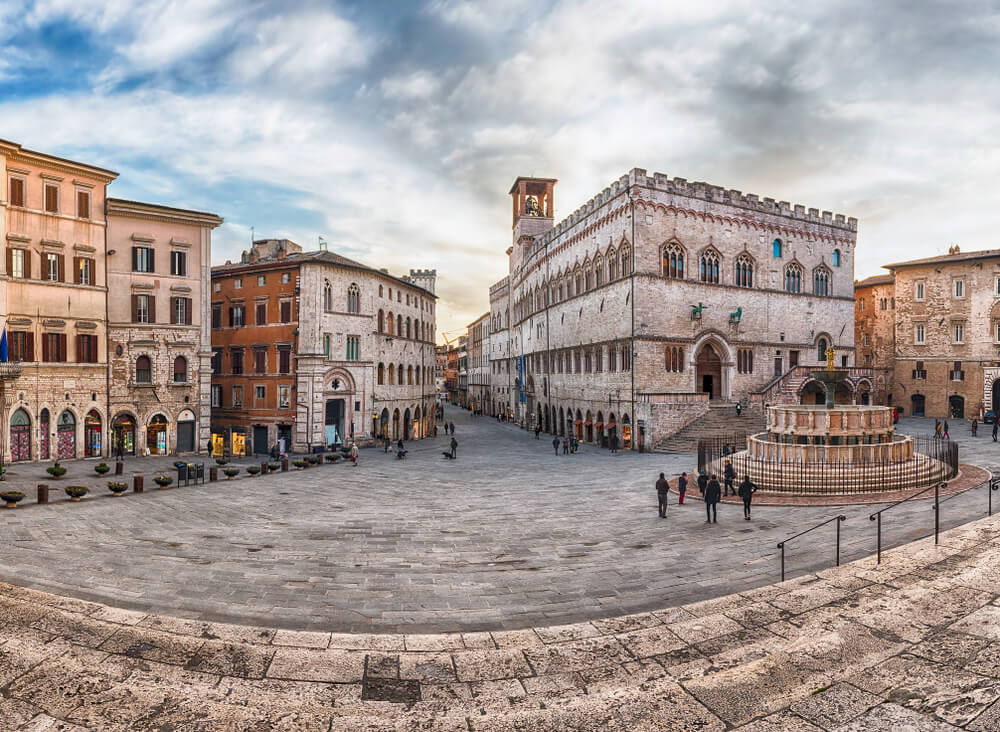
Perugia is a rich tapestry of art, history and culture. Umbria’s capital perfectly combines ancient history with laid back modern living. Its historic centre pulses with student energy thanks to the university, yet its architecture remains a testament to centuries of layered cultures: Etruscan, Roman, Medieval and beyond.
However, when we think of Perugia, we think of two things: jazz and chocolate! As home to Italy’s much loved Baci chocolate brand, Perugia offers many opportunities to enjoy chocolate delicacies at any time of year. But if you happen to be visiting during March or November, you’re in for a real treat. Perugia’s world famous Eurochocolate festival is the continent’s biggest chocolate festival and attracts nearly 1 million cocoa-loving visitors to Perugia’s ancient piazzas. There are chocolate art exhibitions, chocolate sculptures and even a chocolate day spa. But of course, there is also a lot of chocolate eating! The delicious legacy of this festival can be felt all year so don’t despair if you love chocolate and can’t plan your trip during the festival.
Not only is Perugia the capital of Umbria (and perhaps chocolate!) it’s also known as the capital of Jazz. As the main host city of Umbria Jazz each summer, Jazz can be felt all year round with concerts and performances taking place regularly. To read more about Umbria Jazz, Eurochocolate and many more Italian festivals and events click here.
Aside from the jazz and the chocolate, one of our favourite things to do in Perugia is to walk along the raised medieval walkway Via Dei Priori. This is a wonderfully immersive experience – it feels like you’re walking back in time amongst the ancient buildings which surround you on all sides.
Art lovers should also make visits to Palazzo dei Priori, home to the National Gallery of Umbria, and to Sala Del Cambio where you can admire the stunning frescos decorated by Pietro Vannucci. With so much art and history to take in, joining a walking tour with a local guide is the best way to get the most out of your day in Perugia. These can prove popular, especially in the summer months, so book your Perugia tour tickets in advance.
Tips for navigating the city
Assuming that you’ll spend most of your time in the historic centre, Perugia is compact enough to explore comfortably on foot. The streets twist and turn through medieval stone archways, revealing quiet piazzas and sweeping views when you least expect them. Just a word of caution: many lanes are steep, narrow, and paved with ancient cobblestones, so opting for sensible shoes is good advice.
To get up to the old town from the lower parts of the city, the MiniMetrò (Perugia’s automated light railway) is wonderfully efficient and runs throughout the year. It glides you from Pian di Massiano to the edge of the centre in just a few minutes, making the ascent painless.
Alternatively, the network of public escalators – most famously the ones rising through Rocca Paolina – offer an atmospheric (and surprisingly convenient) way to conquer the hill without breaking a sweat.
If you choose to drive into Perugia, be sure to park outside the ZTL to avoid fines. Large car parks such as Piazza Partigiani or Pian di Massiano offer easy access and connect directly to the escalators or MiniMetrò. Take care to double check opening hours or temporary closures before travelling, as local events and markets can occasionally affect availability.
Accommodation and dining recommendations
If you plan to stay overnight in Perugia, you’ll find a variety of accommodation options both within the historic centre and in the quieter neighbourhoods just beyond it. These range from boutique hotels to family-run B&Bs and self-catering apartments with sweeping views over the Umbrian hills. Whatever you prefer, just keep in mind that a tourist tax applies to all stays in the city. The amount varies depending on the type and category of the accommodation but typically is typically just a few euros per person per night. As in many Italian cities, the tax is usually charged only for the first handful of nights and applies to guests above a certain age, so it’s worth checking the exact details when you book.
Perugia is wonderfully easy to reach by car or public transport. So if you’re a fan of space and privacy, we recommend choosing an Umbria villa in the surrounding countryside. In the hills surrounding Perugia you’ll find some of our most stunning villas in Italy. We have something for everyone – large luxury multigeneration villas or smaller serviced apartments tucked into the idyllic Umbrian countryside. And pretty much everything in between. With wonderful gardens and pristine pools, a Bookings For You villa is the perfect place to relax and recharge after a day exploring Perugia.
When it comes to dining, Perugia has something for every appetite. Traditional trattorias serve rustic Umbrian dishes such as strangozzi with truffles, hearty stews, and locally cured meats, while modern cafés and wine bars offer lighter bites and excellent regional wines. Unsurprisingly, you’ll also find chocolate shops and pasticcerie throughout the centre.
One of our favourite spots for dinner is Ristorante Il Giurista. This is a haven for meat lovers and perfect for an authentic Umbrian meal. Set slightly below street level with ancient vaulted ceilings, this restaurant has the added bonus of remaining cool even in the warmest summer months.
For lunch we recommend La Bottega del Gusto. This is one of the most popular sandwich shops we’ve ever visited and we quickly discovered that it was for a very good reason. The sandwiches are delicious and very reasonably priced. There are just two stools inside so we recommend grabbing a sandwich and finding a perch in a nearby piazza.
Spello
Introduction to Spello
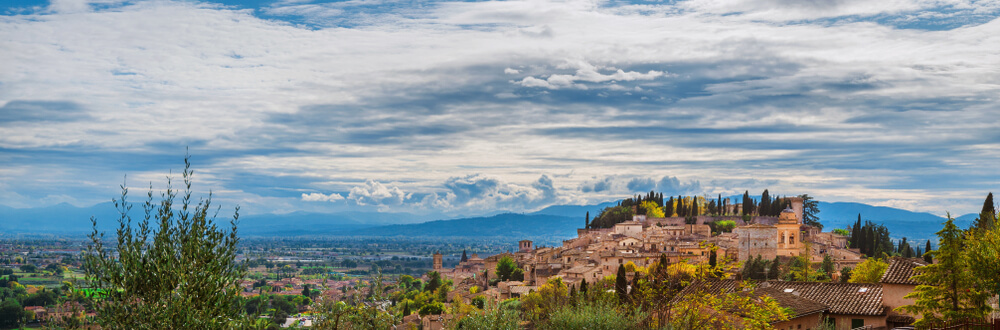
We’ve never made a secret of the fact that Spello is one of our favourite places in Italy. Perhaps the most charming hilltop town in Umbria, it has a long and rich history. A Roman colony from the 1st century BC onwards, Spello was believed to have been founded by the Emperor Augustus. Originally, the town was known as Hispellum. These days, Spello is encased in its Medieval walls but it’s still possible to see plenty of evidence of its Roman ancestors. A recent survey showed that 80 per cent of the buildings lie on Roman foundations and, as you wander around the town, many Roman remains still exist including the three Roman gates – Porta Consolare, Porta di Venere and the Arch of Augustus – along with the old Roman aqueduct.
The list of things to see and do in and around Spello is plentiful and it will take a good few hours to do justice to Spello’s beautifully quaint and historic centre. However, if you are spending a week here, there is more than enough to fill your time – both in Spello and further afield in the surrounding area. Read our extended guide of things to see and do in Spello.
Spello’s most famous annual event is the Infiorata. The event dates as far back as 1831 and is held on the ninth Sunday after Easter to commemorate the Corpus Domini feast. Whilst Spello seems to be filled with flowers all year round, during the Infiorata, the town’s streets are literally paved with over sixty large flower murals. All constructed using flower petals, these carpet Spello’s narrow pavements and roads.
Tips for navigating the city
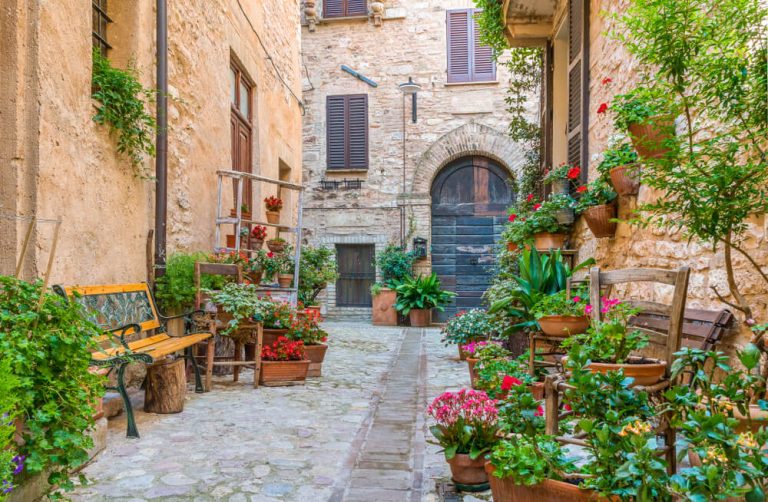
Navigating Spello is easy. You’ll be pleased to know that this Umbrian hill town is wonderfully compact and perfect to explore on foot. Once inside the historic centre, you’ll almost immediately be met with flower filled lanes, Roman arches and picture perfect corners that are all just a short stroll apart.
Spello’s streets are narrow, can be steep and are paved with uneven cobblestones. With this in mind, comfortable walking shoes are essential. You’ll be glad of them as you wander up and down the town’s terraced layout, especially in the warmer months.
Spello is popular with cyclists, particularly those tackling longer Umbrian routes, but be aware that the climb up into the town is steep and sustained. It’s best left to confident riders with a good level of fitness. The reward, of course, is arriving to sweeping views across the Valle Umbra and a well earned espresso in the town’s piazza.
If you plan to arrive by car, note that Spello has ZTL (limited traffic) zones in the historic centre. The most convenient option is to park in one of the designated car parks just outside the old town walls, such as Parcheggio della Porta Consolare or Parcheggio di Porta Venere, both within easy walking distance of the centre. As with many Italian towns, parking availability can change during festivals or market days, so it’s wise to check local notices in advance.
Accommodation and dining recommendations
Spello is the perfect choice for a villa holiday in Umbria. The town is laden with authentic Italian charm and oozes history from every ancient alley and hidden piazza. We are very lucky to have holidayed in Spello many times and have collected a wonderful selection of villas and apartments in Spello along the way for you to enjoy too.
One of our favourites is The Courtyard. Right in the centre of Spello, this stunning apartment offers the best of both worlds: perfect views of the stunning Umbrian countryside from the private terrace but it’s also just a few steps away from the buzz of Spello’s much acclaimed restaurants. Larger groups may prefer Villa Buonanotte Barbanera or Villa Clara. Both are stunning three bedroom Umbria villas with their own private plunge pool. Discover our full collection of magical accommodation in Spello.
Eating in Spello is a real treat. Over time, this relatively small town, tucked right in the centre of Italy, has become home to some of the finest dining options in Italy. One of our favourites for dinner is Il Pinturicchio, a traditional Italian restaurant, serving up excellent quality local food created by Mirko and his wife. It does have an outdoor terrace but it’s small so if you want to sit outside, make sure you book ahead. We recommend trying the tagliata di manzo. It’s worth noting that when we were last there the restaurant was closed on Sundays and Tuesdays.
However the star of the show in Spello has to be Osteria del Buchetto. A much smaller restaurant occupying a terrific position at the top of Spello, it enjoys views of Assisi in the distance. Make sure to book a table on the terrace to make the most of the stunning vista. The owner is incredibly friendly and, whilst he doesn’t speak much English, we feel that this only adds to the authenticity of the restaurant. You will experience a small but perfectly formed menu and absolutely delicious food.
For coffee, an aperitivo or a snack we recommend Bar Tullia. And for the finest pizza in Spello head to Il Vecchio Opificio. Whilst not much to look at, this restaurant serves up the best pizzas in Spello. It’s popular with the locals so even though there is plenty of seating, we recommend you book a table in advance.
Spoleto
Introduction to Spoleto
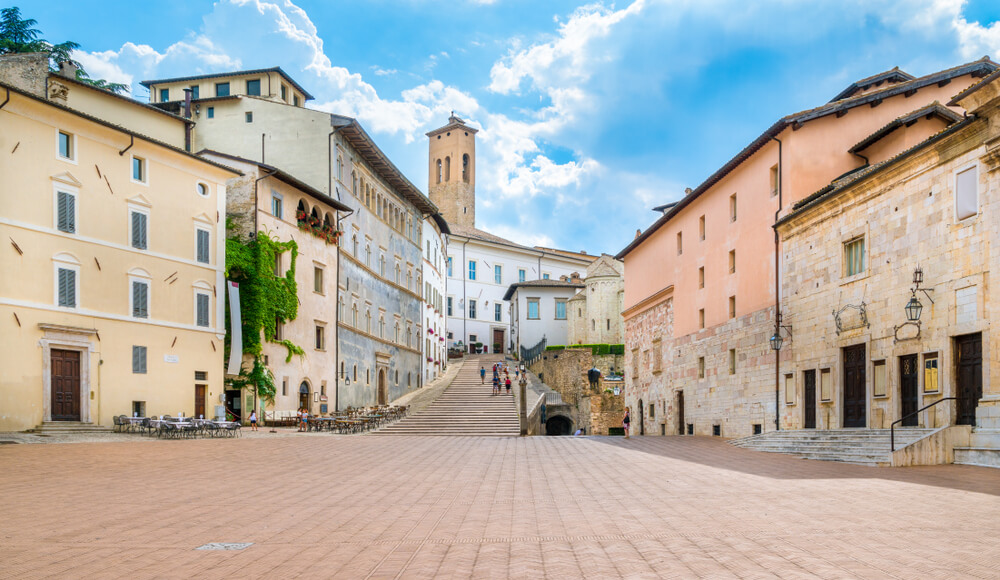
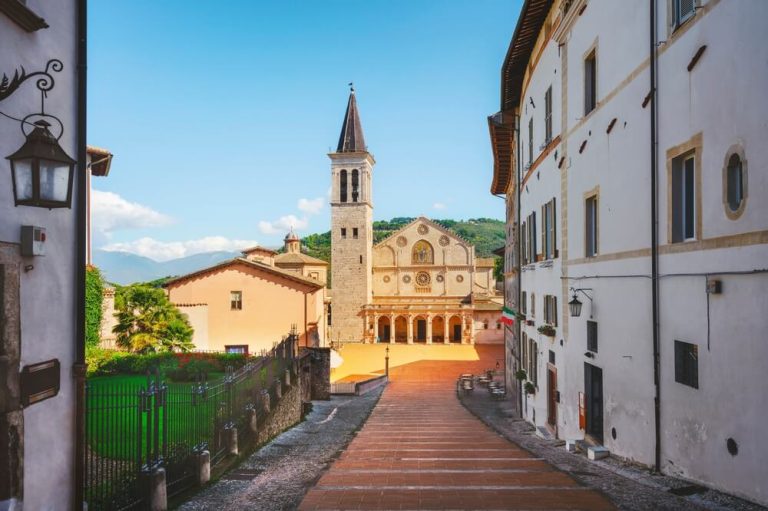
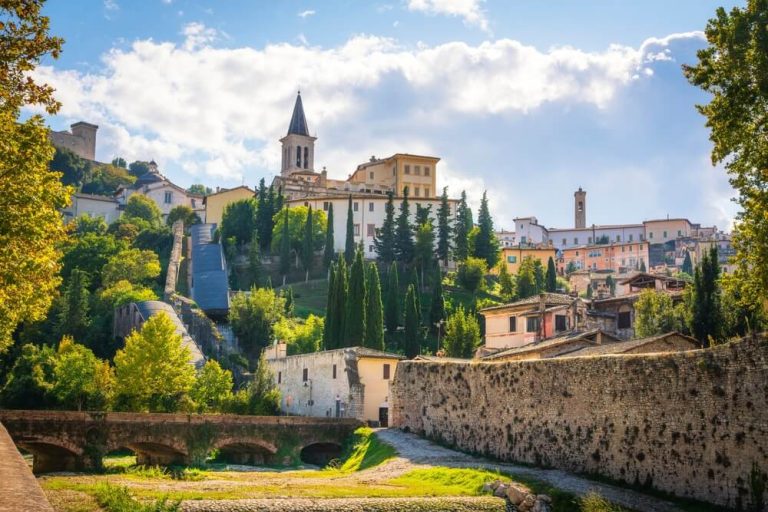
Situated on the foothills of the Apennine mountains, Spoleto is an ancient city in Umbria with much to offer visitors. From the spectacular sight of the Ponte delle Torri aqueduct to the impressive Duomo and the Rocca Albornoziana fortress, there’s plenty to see and do in Spoleto.
The city has a very interesting history. It first grew along the eastern branch of the famous Roman road leading from Rome across the Apennines to Rimini on the coast. As a result, the city is full of remains of its Roman past – from the 1st Century Ponte Sanguinario (the ‘bloody bridge’) to the 2nd Century Roman amphitheatre. Under Lombard rule, the town became the capital of the Duchy of Spoleto and ruled over a significant proportion of central Italy. Spoleto was later ruled by various Popes, fought over by the Guelphs and Ghibellines, and even Napoleon took charge until it was eventually captured and unified with the rest of Italy.
Today, Spoleto is most famous for the Festival dei Due Mondi (Festival of the Two Worlds), which was founded in 1958. The concept behind the festival name was to showcase American and European culture within the same event, emboldened by a sister event held in South Carolina. Over time, the event has evolved into a three week festival of art, music, drama, and dance.
Tips for navigating the city
Spoleto’s historic centre is compact enough to explore with ease on foot, and walking is by far the best way to appreciate the town’s layered history and beautiful viewpoints. Once inside the old town, most sights are close together, although the terrain can be more challenging than it first appears.
Spoleto is built on a hillside, so expect steep streets, lots of steps and uneven cobblestones throughout the centre. Comfortable walking shoes are essential, especially if you plan to visit landmarks such as the Duomo or wander up towards the Rocca Albornoziana. The climbs can be tiring, but the views across the valley make every step worthwhile. We see it as another excuse to stop for a coffee or gelato to recharge.
To make getting around easier, Spoleto has an excellent free network of escalators and moving walkways that connect parking areas (lower down the hillside) with the upper parts of the town. These are incredibly useful and save a lot of energy, particularly in the height of the summer. They’re well signposted and simple to use, even if it’s your first visit.
Some cyclists do tackle the ascent into Spoleto, however we believe this is best left to experienced riders. The climbs are steep and continuous, and traffic can be challenging in places. As with many Umbrian hill towns, reaching the top is the hardest part. Once you’re up the hill, exploring is far more relaxed – although Spoleto’s cobbled streets are not very bike friendly!
If you’re arriving by car, there are several large car parks outside the ZTL, including areas near Piazza d’Armi and the main escalator routes. Always check signage carefully, as access restrictions are strictly enforced and can change during festivals or events, particularly during the Festival dei Due Mondi.
Accommodation and dining recommendations
While you can, of course, stay in the centre of Spoleto, given that it’s so easy to reach from the surrounding countryside, we recommend finding an Umbria villa rental outside the city. The countryside around Spoleto is some of the most stunning in all of Italy and we definitely recommend spending at least part of your Umbria villa holiday here. If you’re travelling in the height of the summer, then we recommend finding somewhere with a pool to cool off. Discover our full collection of Umbria villas with pools.
That said, if you do want to stay in the centre of Spoleto there is a reasonably good selection of hotels and B&Bs to choose from. Aiming to be as close to the centre of the old town as you can is good advice.
Wherever you choose to stay, you must make sure to spend at least one evening in Spoleto itself. As night falls, the city is illuminated, highlighting the very best of its historical features. Likewise, dinner in Spoleto mustn’t be missed. One of our favourite spots is Ristorante Il Tempio del Gusto. The menu leans towards tradition with a modern touch, making it ideal for a special dinner without feeling overly formal.
Another very good option is Trattoria La Torretta. Popular with locals, we recommend booking a table here in advance. The food is honest, generous and unapologetically authentic Umbrian. This is a great place to try regional staples such as strangozzi pasta with truffle or rich meat sauces, served in a cosy setting that feels wonderfully unchanged by time.
For something more casual, Osteria dello Sportello is an excellent choice. Tucked away on a quiet street, it offers simple, seasonal dishes and a laid back atmosphere that’s perfect after a day of exploring Spoleto’s riches.
For a sweet treat, pop into Gelateria Crispini. Well known across Umbria, this gelateria serves some of the best artisanal gelato in the region, made with high quality ingredients. It’s ideal for an afternoon pause or a post-dinner stroll through town.
Finally, for a very good glass of wine or an aperitivo, we recommend Il Mio Vinaio. This small, but perfectly formed wine bar focuses on natural and regional wines, and it’s the kind of place where one glass easily turns into two. It’s relaxed, friendly, and a perfect spot to soak up Spoleto’s evening atmosphere.
Todi
Introduction to Todi
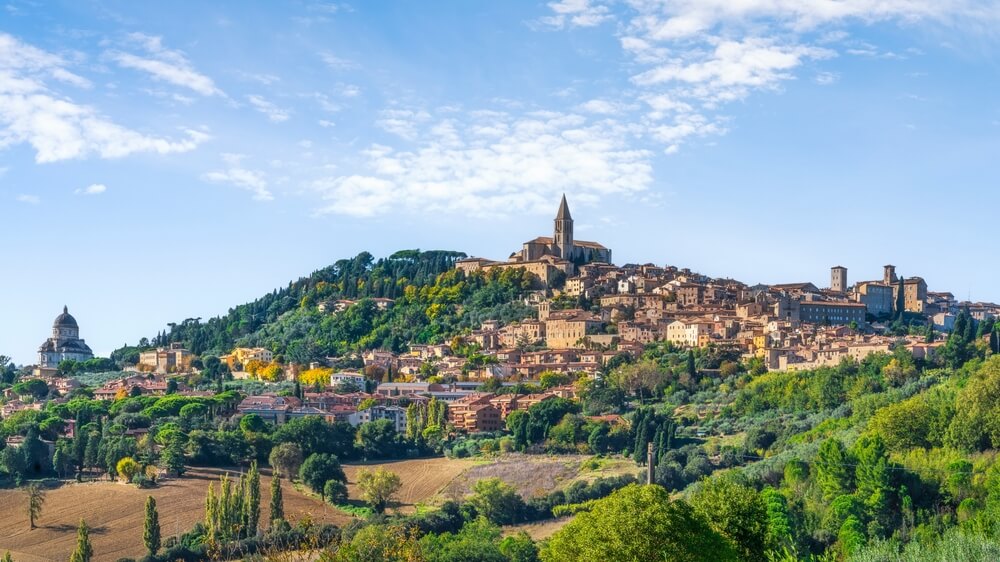
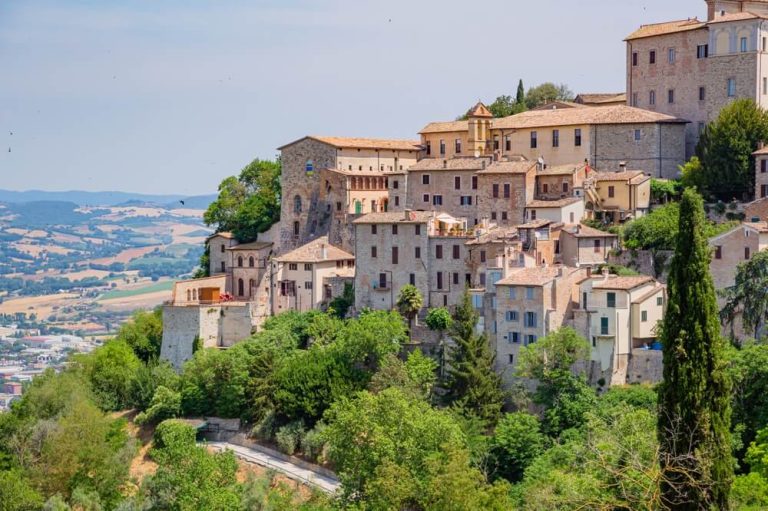
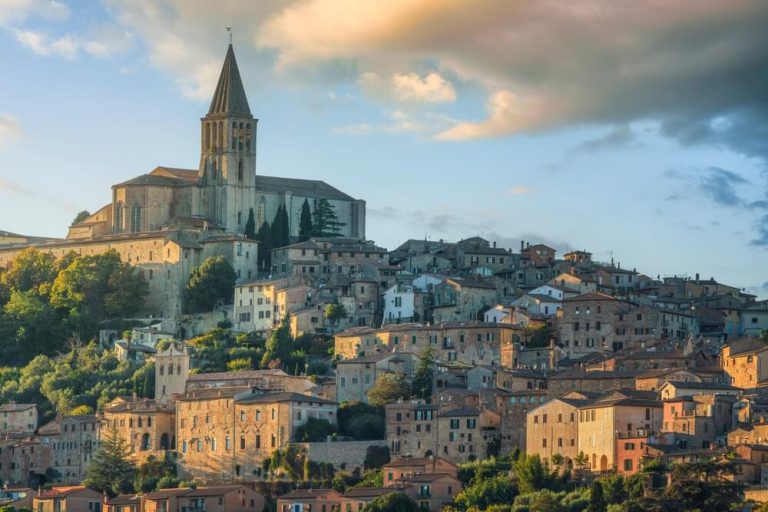
Situated in the heart of Umbria – almost equidistant between Spoleto and Orvieto – Todi is a hilltop town with a long and fascinating history. Nestled on the steep slopes of a 400 metre high hill, which sits on the banks of the River Tiber, legend has it that the founders of the city had originally planned to build Todi at the foot of the hill. However, whilst enjoying their breakfast one morning, an eagle is said to have swooped down and flew away with their blanket – discarding it over the top of the hill. It was decided that this was an omen and construction of the town instead began on the hilltop. Take a look at Todi’s coat of arms and you won’t be surprised to see that it features this legendary eagle.
Many buildings from Todi’s rich and illustrious history still survive today. Those from Roman times include the Roman basilica and Roman forum. However, to fully discover this part of Todi’s history, you also need to head underground. Below the rectangular Piazza del Popolo there are a series of 1st century Roman cisterns (cisterne Romane). These are over 80 metres long and visitors can explore them all. Originally, they were part of a rainwater drainage and storage system that would have taken water from the Roman forum down to the valley below.
One of our favourite things about Todi is how the history of the city is very clearly visible in the rings that circle the town. The innermost circle was built by the Etruscans, the middle ring by the Romans and the outermost ring by those living during the Middle Ages, a time believed to be Todi’s heyday.
Much of what you see today in Todi dates back to the Middle Ages. This is when Todi was at its most prosperous. The first and perhaps finest example of this prosperity is Todi’s 13th century Romanesque-Gothic cathedral. This is situated in the Piazza del Popolo. The facade of the Duomo is actually quite simple, however inside the interior is more impressive. Look out for Ferrau da Faenza’s copy of Michelangelo’s Last Judgement on the far wall. Just don’t expect to be too impressed by it!
The altar, designed and built by Gianncolo di Paolo, is far more impressive as is the central rose window. You need to be inside to see this at its best and ideally when the natural Umbrian light streams through. We recommend paying the small fee to head underground to explore the crypt too.
One of Todi’s finest attractions, the Piazza del Popolo, is widely acknowledged to be one of Italy’s most perfect Medieval piazzas. So is a definite must-see on your Umbria villa holiday. Also in this incredibly beautiful square are three equally impressive palaces: the Palazzo dei Priori, the Palazzo del Popolo and the Palazzo del Capitano. All three were built by the commune in an attempt to out-do the church. As a result, you’ll find them to be much more ornate than the Duomo. For those interested in learning more about the history of Todi under the Etruscans, then the Palazzo del Capitano is also home to the Museo Etrusco-Romano which contains a number of important artefacts.
Todi hosts a weekly market every Saturday in Via Menacali. This is a great time to visit if you’re a keen foodie. And every second Sunday of the month, Todi also plays host to an antiques market in Piazza del Popolo. Otherwise, the biggest annual event in Todi is the Todi festival held at the end of August and beginning of September each year. Lasting more than a week, it’s a chance to immerse yourself in theatre, music, dance, art and literature.
Alternatively, if you prefer to explore off season and are staying in an Umbria villa in the Winter months, the run up to Christmas is also a lovely time to visit Todi. The slope of the hill is lit up by a gigantic Christmas tree (although it’s not as big as the one in Gubbio!) and there are Christmas markets to get you in the festive spirit. To kick off the festive season, Todi hosts an annual market, usually on or around the 11th November. The Fiera di San Martino hosts over 100 stalls stretching from Piazzale della Consolazione to Piazza del Popolo.
Tips for navigating the city
Once you arrive in the centre of Todi, you’ll soon find that the medieval streets, elegant piazzas and panoramic viewpoints are all within easy walking distance.
Todi sits high above the Tiber Valley, and while the centre itself is relatively gentle compared to some Umbrian hill towns, you should still expect sloping streets and uneven stone paving. Wear comfortable shoes, especially if you plan to wander beyond the main piazza and into the quieter residential lanes.
Getting up into the old town is made much easier by Todi’s escalator system, which connects the lower parking areas with the historic centre. This is a real bonus, particularly in hot weather, and makes arriving by car far less daunting than you might expect.
Cyclists often pass through Todi as part of longer Umbrian routes, but the final climb into town is long and demanding. As always, the reward at the top is a beautiful town and sweeping views across the surrounding countryside.
If you’re driving, there are several convenient car parks below the historic centre, including areas near Porta Orvietana and the escalators. Be mindful of the ZTL, which is clearly signposted and strictly enforced. It’s always worth checking for any temporary restrictions during local events or market days before you arrive.
Accommodation and dining recommendations
The centre of Todi is quite compact and while you can find some hotels and B&Bs in the old town, access to Todi is so easy that we don’t think it’s necessary to stay in Todi itself to discover this wonderful Umbrian hilltop town.
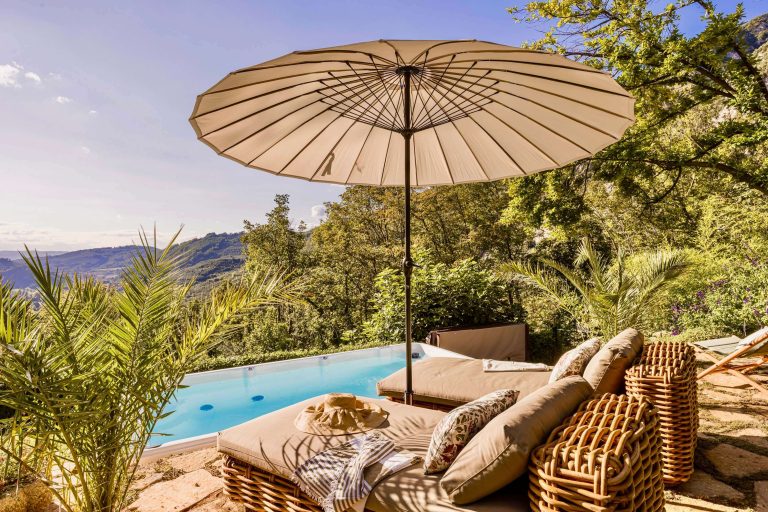
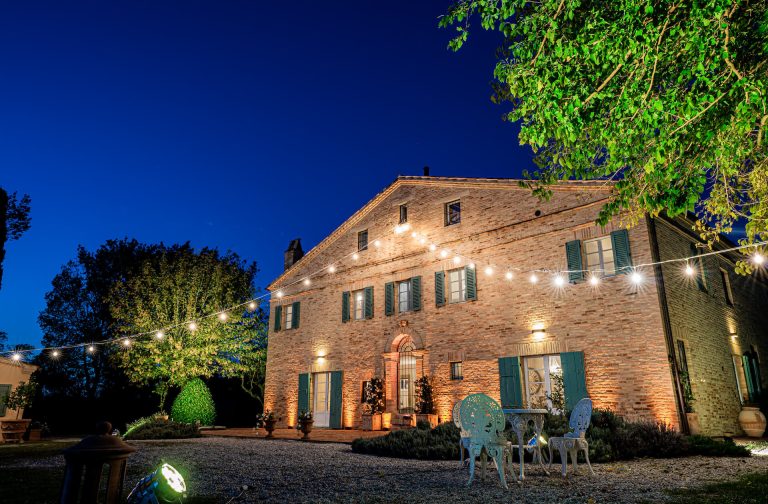
Our recommendation is to opt for a villa in Umbria so you can have a base from which to explore not just Todi but also Orvieto, Spello and Spoleto which are in such easy reach of each other. Villa d’Arte is the perfect choice. Just 9km from the centre of Todi and with extensive gardens and a private pool, this fabulous 4 bedroom villa boasts some of the finest views in the area. Or, explore our full collection of magical villas and apartments in Umbria.
Wherever you choose to stay, we always recommend that our guests spend at least one evening in Todi. As is the case in all Umbrian towns, dinner and the preceding aperitivo definitely give the best experience in Todi. For an evening meal or a leisurely lunch, start with Osteria del Grillo, a beloved local spot tucked just off the main piazza. Despite its central location, don’t expect tourist menus. Here you’ll find Umbrian classics done with care. Think rich pastas, seasonal truffles and slow cooked meats – all paired with a thoughtful list of regional wines. The atmosphere is warm and welcoming, perfect for lingering over multiple courses and good conversation.
Another excellent choice is Ristorante Il Maiale Felice, known for its inventive approach to traditional flavours. While staying true to local ingredients, the chefs here add a creative twist that keeps every dish interesting. This is an ideal place for a slightly elevated dinner that still feels grounded in Todi’s culinary heritage.
For something more casual, we love La Cantina. Popular with locals this place offers hearty fare in a rustic setting. It’s a great pick for sampling Umbrian comfort food like strangozzi with pesto di nocciole (hazelnut pesto) or a generous antipasto board, alongside locally produced wine. The vibe is relaxed and unpretentious.
If you’re in the mood for something sweet, be sure to visit Gelateria Follie di Gusto. This artisanal gelato shop uses fresh, seasonal ingredients to create beautifully balanced flavours, from classic stracciatella to inventive fruit combinations.
Finally, for a great glass of wine or an aperitivo before dinner, we recommend Vineria San Fortunato. Cozy and atmospheric, it’s a wonderful spot to sample Umbrian reds or sparkling wines while soaking up views of Todi’s piazzas as the sun begins to set.
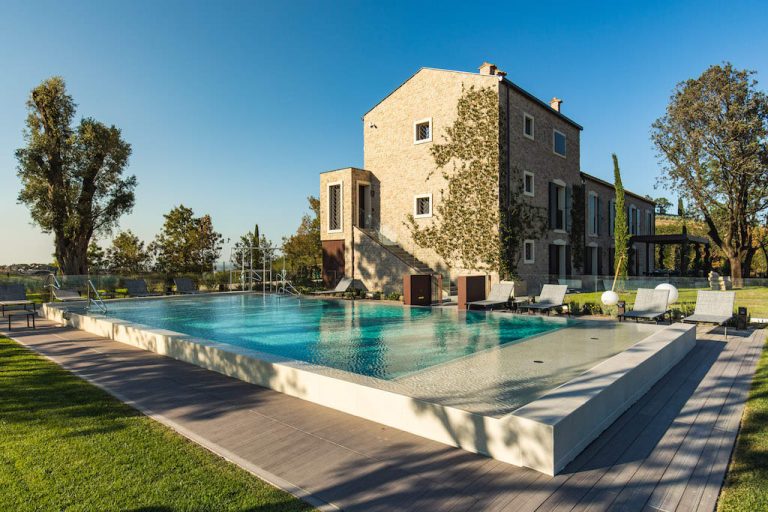
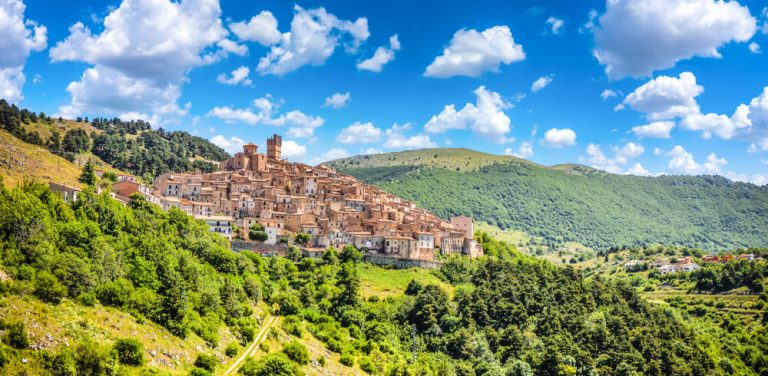
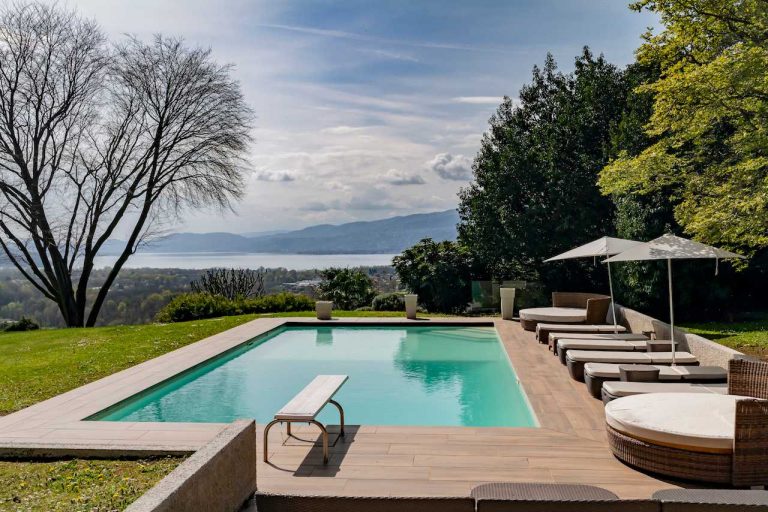
Things to do in Umbria
History and Culture
Umbria is often celebrated for its peaceful landscapes and beautifully preserved hilltop towns. Steeped in history and oozing authentic Italian culture, the whole region is a haven for those travellers looking to discover history and culture in Italy at its best. Known as Italy’s “Green Heart”, Umbria sits at the centre of the peninsula and has been inhabited since prehistoric times. Long before Rome rose to power, the region was home to the Etruscans, whose legacy can still be seen in towns such as Orvieto and Perugia.
Under Roman rule, Umbria became strategically important, with roads, theatres and civic buildings shaping the landscape. Many of these ancient foundations remain visible today, subtly woven into medieval streets and piazzas. After the fall of the Roman Empire, Umbria passed through the hands of various powers, including the Lombards and the Papal States, shaping its identity as a deeply religious and culturally rich region. It officially became part of a unified Italy in the 19th century.
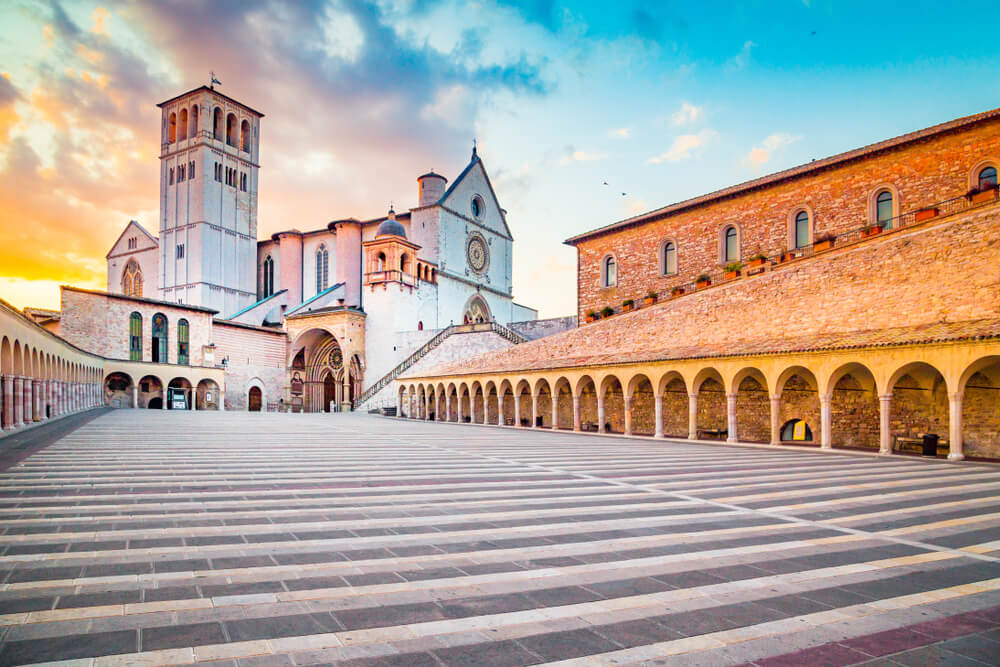
Umbria’s hilltop towns are perhaps its greatest cultural treasure. Places like Assisi, Spoleto, Gubbio and Todi are living museums, where Roman ruins, medieval palazzi and Renaissance churches sit side by side. The Basilica of Saint Francis in Assisi is one of Italy’s most important religious sites, while Gubbio’s Palazzo dei Consoli and Spoleto’s Roman theatre tell stories of civic pride and artistic achievement spanning centuries.
Religion, craftsmanship (especially in food!) and community life are deeply woven into Umbrian culture. This is reflected not only in grand basilicas and monasteries, but also in local festivals, traditions and food culture which has been passed down through generations. From ancient olive oil production to medieval celebrations, Umbria offers countless ways to connect with Italy’s past and learn about Umbrian culture first hand.
Whether you’re wandering a quiet piazza, exploring an ancient church or enjoying a long lunch overlooking rolling hills, Umbria’s history and culture are never far from the surface — and that’s exactly what makes the region so special.
Vineyards and wineries
Umbria is home to some exceptional wines, and visiting a vineyard is one of the most rewarding experiences in the region. Spend an afternoon tasting Sagrantino di Montefalco, one of Italy’s most powerful red wines, or enjoy lighter whites and rosés produced in small, family-run wineries. Many vineyards offer guided tastings paired with local cheeses and cured meats, giving you real insight into Umbrian food culture.
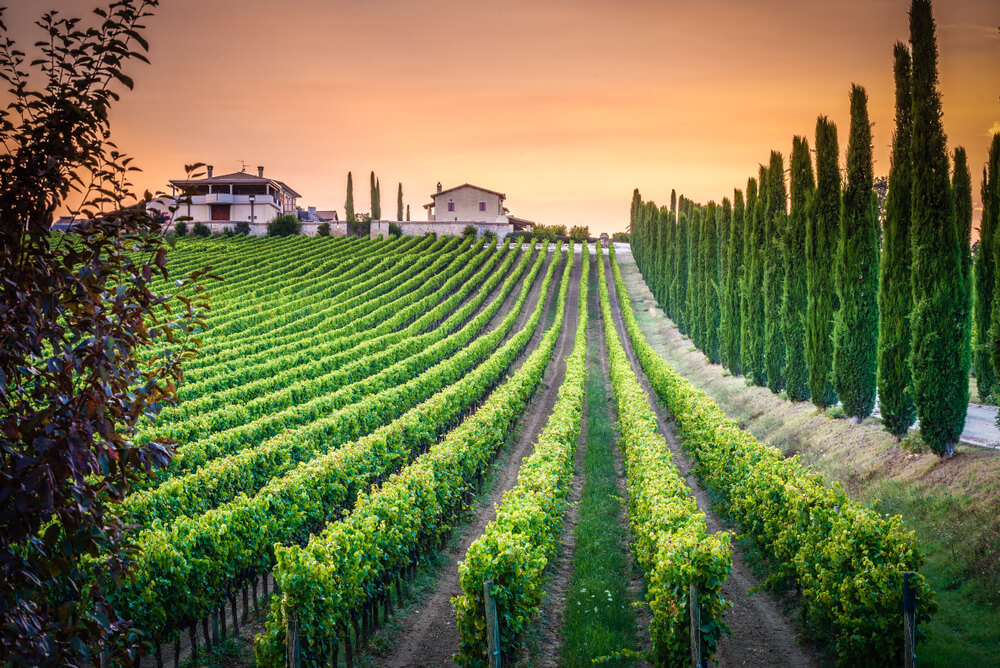
If you’re looking for an exceptional wine tasting experience in Umbria, look no further than spending a couple of hours with Roberto and his family at Enotica Properzio in the heart of Spello. Roberto, a larger than life character, and an impeccable host, and his knowledge of wine is second to none. Guests are warmly welcomed and treated to a superb array of wines accompanied by the most delicious, home made food. Located in the centre of Spello, a beautiful old town dating back to Roman times, the enoteca has tables both inside and outside, either at the front or in a more private rear garden.
Exploring the Umbrian countryside
Umbria’s countryside is quietly spectacular. Rolling hills, olive groves, vineyards sit alongside pockets of wild, mountainous terrain. We often think that Umbria’s countryside is just as beautiful as Tuscany’s but with the bonus of being less discovered by tourists.
Umbria is well known as the ‘green heart of Italy’ and not surprisingly given it’s name, it is ideal walking territory. With an abundance of national parks to choose from, many of the areas are protected ensuring that Umbria’s natural beauty will be preserved for future generations.
The parks include the Monti Sibillini National Park as well as a number of smaller regional parks, among them Colfiorito, Monte Cucco, Monte Subasio, the Tiber River Park, Trasimeno and the Nera River Park. In addition there is the Parco STINA and some smaller reserves such as the parks of Sette Frati and Villalba, Lake Alviano and La Valle.
The largest of the parks – the Monti Sibillini National Park – is a wonderful place for hiking. Covering nearly 18,000 hectares, this is a nature lovers paradise with nearly 2000 species of flowers from edelweiss to orchids. The Monte Cucco regional Park just as good for anyone interesting in hiking. The scenery here is just as breathtaking, with an equal abundance of wildlife, from crayfish in the rivers, to eagles in the air and wolves in the forests. With over 120 kilometres of trails in the park, the difficulty will be knowing which route to choose! For the birdwatcher enthusiasts out there, opt for walks in the Colfiorito Regional Park.
For lovers of open landscapes and mountain scenery, the Monti Sibillini National Park is the standout choice. Straddling the border between Umbria and Marche, this protected area offers high plains, rugged peaks and some of the most dramatic views in central Italy. The Piano Grande near Castelluccio di Norcia is particularly breathtaking, especially during La Fioritura, when the fields burst into colour. Hiking routes here range from gentle walks to challenging mountain trails, making it suitable for a variety of abilities.
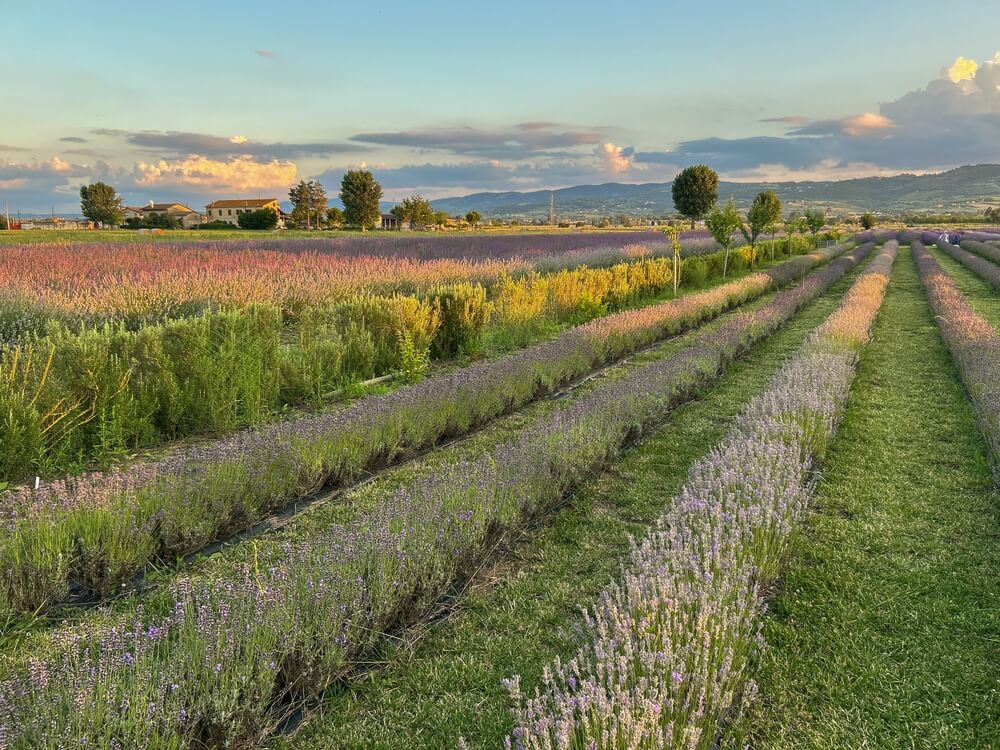
If you prefer gentler countryside, the valleys and hills of central Umbria provide a softer, more pastoral experience. Areas around Montefalco, Bevagna and Todi are ideal for scenic drives, cycling and walking through vineyards and olive groves. These landscapes invite slow exploration, with plenty of opportunities to stop one of Umbria’s picturesque villages for refreshment along the way
Nature lovers may enjoy the wooded areas and nature reserves scattered across the region, where quiet trails offer the chance to spot local wildlife and enjoy peaceful surroundings far from the crowds. Guided walks can be a great option if you want to learn more about the land, its history and its flora.
Umbria’s landscape is exceptionally rewarding for cyclists too. Rolling countryside, olive groves and vineyard-lined valleys create ideal conditions for scenic rides, while the region’s famous hill towns offer more challenging routes for those looking to test their legs.
In the valleys and rural areas, roads are often quiet and gentle, making them well suited to road cycling. Routes around Lake Trasimeno, for example, are relatively flat and particularly popular, offering long, peaceful rides with open views and minimal traffic. These areas are ideal for leisure cyclists or those looking for longer, steady days in the saddle.
For more experienced riders, Umbria’s hilltop towns provide demanding climbs and exhilarating descents. Towns and cities such as Assisi, Spoleto and Gubbio sit high above the surrounding plains, and the roads leading up to them are steep and quite unforgiving. While these climbs are not for beginners, the rewards at the top — panoramic views and the satisfaction of the ascent — are considerable.
Mountain bikers are equally well catered for, with off-road trails, forest tracks and mountain paths, particularly in areas like the Monti Sibillini and the Apennine foothills. These routes offer a wilder, more rugged cycling experience and are best suited to riders with some off-road experience.
Wherever and however you choose to explore, Umbria’s countryside rewards those who take their time. Whether you’re hiking, driving, cycling or simply enjoying the view, look around and savour the moment.
Best Places to Visit in Umbria
As well as Umbria’s larger towns and cities, there are also a number of smaller towns and villages we recommend you visit, as well as a number of other sights that showcase the beauty of this region of Italy.
Cascate delle Marmore
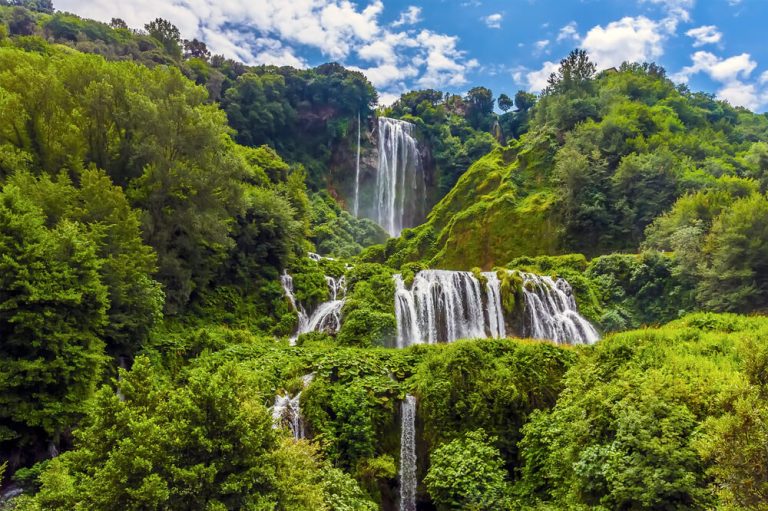
This is the largest man-made waterfall in the world and a truly magnificent sight. It was actually built by the Romans, so it’s had plenty of time to settle into its stunning natural setting. At a staggering 165 metres high, the falls are a must see destination if you’re visiting Umbria. While the falls are split across three levels, there are many viewing platforms from which to enjoy the wonderful vistas and take some fantastic photos. An entrance fee gives to access the falls, all the hiking trails and amenities in the park.
Lake Trasimeno
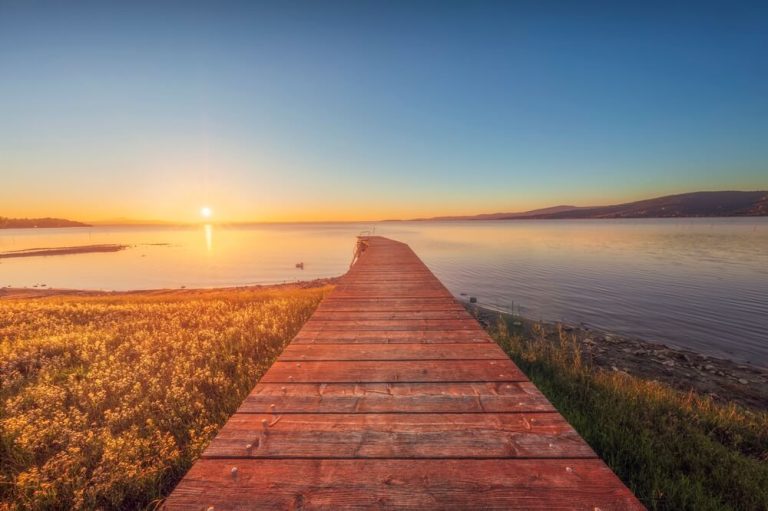
Lake Trasimeno is somewhat of a hidden gem in Umbria. At 128 square kilometres, it’s just slightly smaller than Lake Como. Yet at only five metres deep, it maintains a wonderfully mild temperature for swimming and water activities from the spring well into the autumn. Kayaks and paddle boards are available to rent. However, we recommend using a guide to help you stay safe while also getting the most out of your experience on the water. The best place to begin your visit is on Lido di Tuoro. We also recommend joining a boat tour to explore the picturesque islands of Polvese and Maggiore.
Trevi
Perched on Monte Serano, Trevi towers over the iconic rolling green hills of the Spoleto valley. Like many of its neighbours, Trevi has a rich history peppered with different rulers and, while under Roman rule, it was a key town situated on the Via Flaminia. Modern day Trevi is divided into two parts: Borgo Trevi and the Centro Storico. Spend your time in the latter. Enter through one of the Medieval city gates: Porta del Bruscito, Porta San Fabiano or Porta del Cieco. Then follow the Via Roma and you will reach Piazza Mazzini, Trevi’s central square. A farmer’s market is held here every fourth Sunday of the month. It is also the setting for the abundance of festivals that Trevi hosts each year. Our favourite is the Black Celery Festival! Find out more in our guide to Trevi.
Monte Sibillini National Park
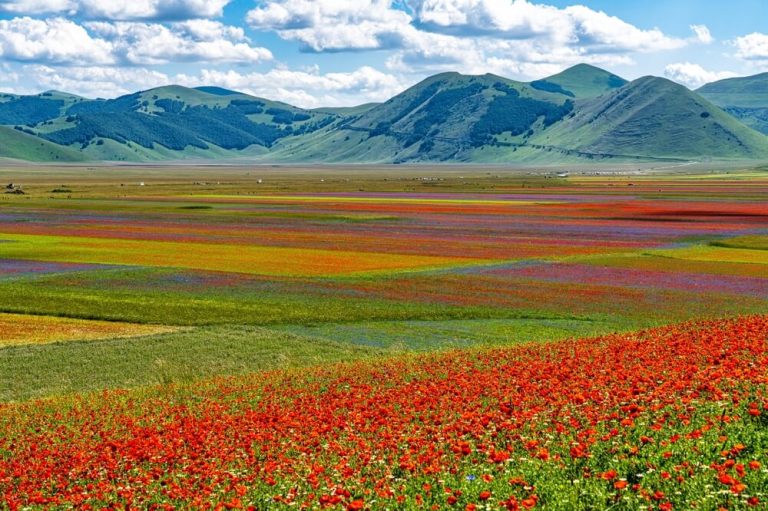
A visit to the Monte Sibillini National Park offers the chance to explore some of the most dramatic and unspoilt scenery in central Italy. Stretching across Umbria and neighbouring Marche, this protected mountain range is a haven of wild landscapes, quiet villages and outdoor adventure, perfect for travellers who enjoy nature, walking and wide open spaces. The park is defined by its rolling high plains, rugged peaks and deep valleys, with Mount Vettore standing as the highest summit. One of the most iconic areas is the Piano Grande near Castelluccio di Norcia, where vast, open fields transform each spring and early summer during La Fioritura. At this time, the plain bursts into colour with wildflowers blooming in vivid reds, yellows and purples – one of the most beautiful natural spectacles in Italy. Fans of hiking and walking will find trails suited to all levels.
Montefalco
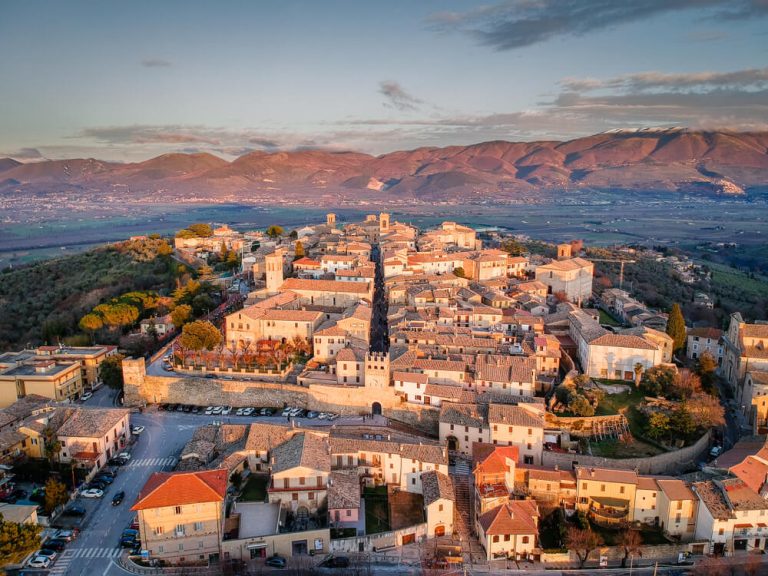
Since Roman times, Montefalco has been at the heart of Umbria’s wine production. Today, you’ll find that many of the town’s shops revolve around food and wine. This alcoholic tipple is celebrated a number of times during the year. At Easter there is the Terre del Sagrantino and on the last Sunday in May there is Cantine Aperte. At this time, you can taste the wines directly in the cellars or vineyards where they are produced. There are also 3 weeks of celebrations in the town in August as well as the Festival Calici in December.The town is beautiful and not to be missed, not least because its home to a couple of our favourite restaurants in Umbria – Locanda del Teatro and L’Alchimista.
Norcia
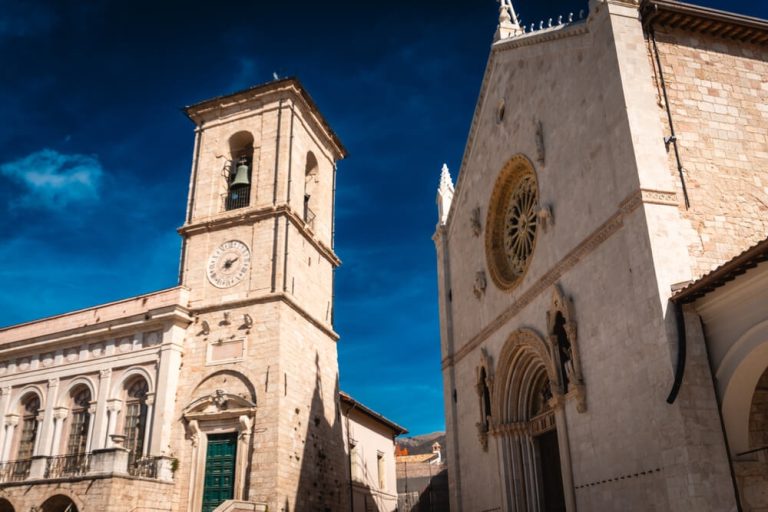
Renowned for its exceptional food, and specifically its pork products (norcineria), cured meats and truffles, Norcia is one of Umbria’s most compelling destinations for holidaymakers seeking authenticity, beauty combined with culinary expertise. Set against the backdrop of the Sibillini Mountains, the town is also the birthplace of Saint Benedict, the founder of western monasticism. Sadly, much of the town was destroyed by an earthquake in 2016, but it is being rebuilt.
Foligno
Whilst much of Foligno dates to the mid 20th century since large parts were destroyed in WWII, it is still worth a visit, especially during the spectacle of the Palio della Quintana. This is a super exciting event during which ten horsemen must gallop along and insert their lance into a ring whose diameter decreases with each run. There are three jousts each year – in February, June and September.
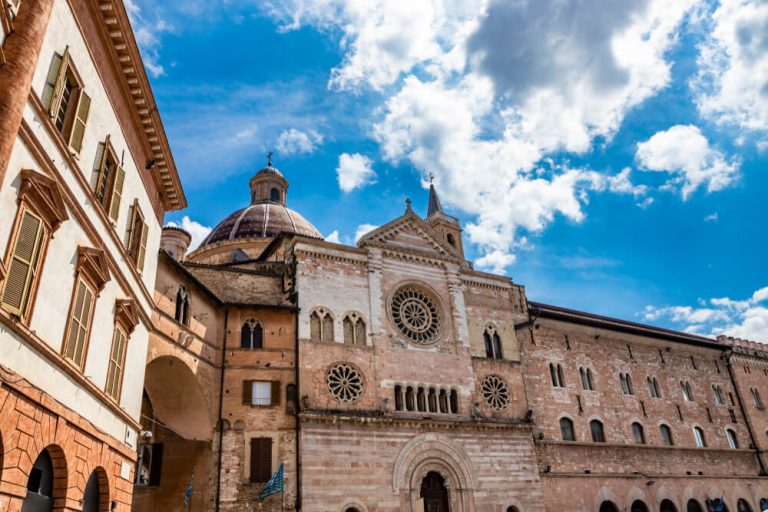
Bevagna
Another charming Umbrian town, Bevagna has very much preserved it’s medieval appearance but it’s clear to see it’s Roman roots in the layout of the streets and the glimpses of the Roman outer walls. The ruins of the Roman temple were also transformed into the church of the Madonna della Neve. There are a few small boutiques worth visiting in the town, a couple selling some wonderful cashmere goods and it’s also worth visiting the Churches of San Silvestro and San Michele Arcangelo. The city’s museum is housed in the Palazzo Lepri.
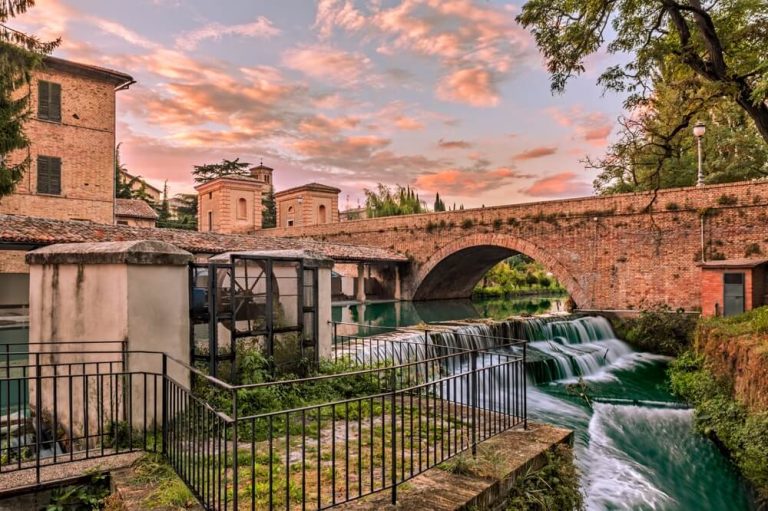
What to Eat and Drink in Umbria
Umbrian cuisine is deeply connected to the land. The region’s food reflects its agricultural roots, with an emphasis on seasonal produce, slow cooking and simple techniques that allow ingredients to shine. Meals in Umbria are rarely rushed and are as much about tradition and togetherness as they are about flavour – although we’re sure you won’t be disappointed with the flavours either!
Strangozzi
Strangozzi is the most recognisable pasta of Umbria and a staple on menus across the region. Hand-rolled and slightly thicker than spaghetti, this pasta has a satisfying bite and is designed to carry simple, robust sauces. It’s most famously served with black truffle, but also pairs beautifully with tomato, garlic, chilli or slow-cooked meat ragù.
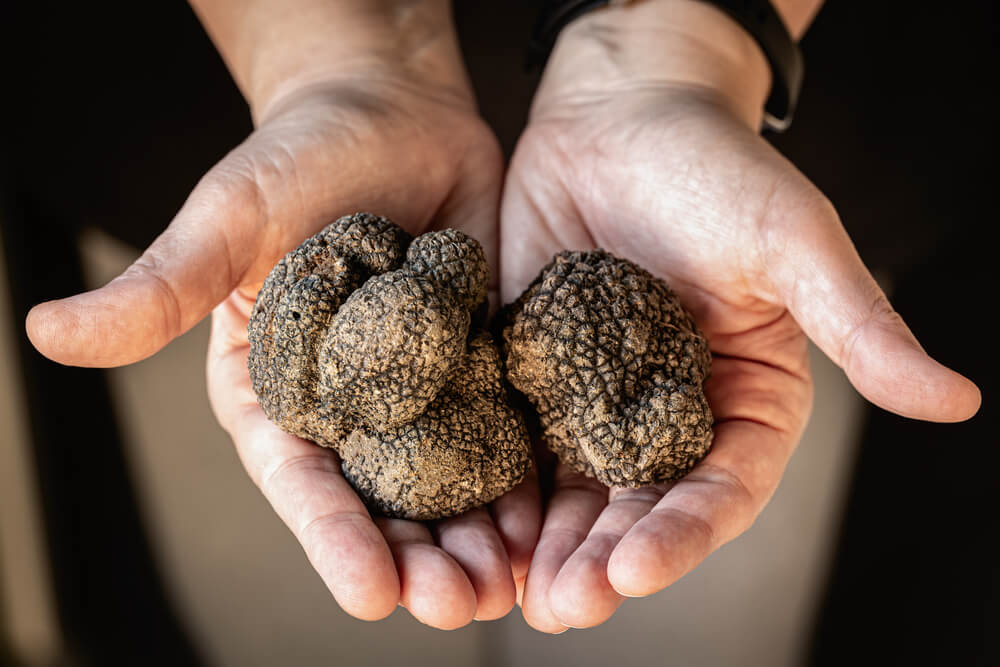
Black Truffles (Tartufo Nero)
Umbria is one of Italy’s premier truffle regions, particularly known for its black truffles harvested around Norcia, Spoleto and the Valnerina. Unlike white truffles, black truffles are often cooked or gently warmed to release their aroma. You’ll find them shaved over pasta, eggs, bruschetta and meat dishes. Truffle season varies, but black truffles are more often found during the winter months. Enjoying them at their freshest is one of Umbria’s great culinary pleasures.
Porchetta
Porchetta is a beloved Umbrian comfort food, traditionally made by slow-roasting pork seasoned with garlic, rosemary, fennel and wild herbs. Crisp on the outside and tender on the inside, it’s commonly eaten in sandwiches at markets, festivals and roadside stalls. It’s also served as a main course in traditional restaurants, often accompanied by roasted potatoes or seasonal greens.
Cinghiale (Wild Boar)
Wild boar is central to Umbrian cuisine, particularly in inland and mountainous areas. It’s most commonly found in rich ragù sauces served with pasta or as slow-braised meat, cooked for hours to tenderise the robust flavour. These dishes are deeply satisfying and pair perfectly with Umbrian red wines. If you are in Umbria during the colder months of the year, these dishes are some of the most hearty and warming on winter menus.
Torta al Testo
Torta al Testo is a traditional Umbrian flatbread cooked on a hot stone or griddle. Once cooked, it’s sliced open and filled with cured meats, cheeses, sausage or grilled vegetables. Simple yet incredibly comforting, it’s a popular choice for casual lunches and quick meals, especially in smaller towns and villages. We often find stalls at local markets serving up torta al testo – the perfect place to try one of our favourite Umbrian snacks.
Rocciata di Assisi
Often described as Umbria’s answer to strudel, rocciata is one of the region’s most traditional desserts. Originating in Assisi, it’s made by rolling thin dough around a filling of apples, walnuts, pine nuts, raisins, cocoa and spices before baking until golden. Lightly dusted with sugar and sometimes finished with a splash of liqueur, rocciata is comforting and delicious. It’s commonly enjoyed during festivals and family gatherings, but you’ll also find it in bakeries, markets and traditional restaurants across the region.
The Best Time to Visit Umbria
Autumn is one of the best times to visit Umbria. As the season turns from Summer to Autumn, and the leaves turn and fall from the trees, the region comes alive with beautiful shades of red, orange and yellow. What is more, the weather at this time is still usually lovely with plenty of sunshine. Expect average high daily temperatures to sit between 20°C to 25°C. Despite the warm weather, this time of year is relatively quiet when it comes to visitor numbers. The exception to this is in Assisi when the Feast of St Francis takes place in early October.
Autumn is the best time to sample Umbria’s food too. Mushrooms, truffles and saffron are all harvested in these months, as are grapes and olives. Head to Gubbio at the end of October to join in the celebrations of the white truffle harvest.
Alternatively, visit Umbria in the Spring when the countryside is awash with wonderful wildflowers. March sees the first blossom on the trees and daily high temperatures around 13°C, increasing to 17°C in April. At this time of year visitors start to explore the region in greater numbers, particularly at Easter when thousands descend on the birthplace of Saint Francis in Assisi. But, that said, it’s still pretty quiet and you can certainly access Umbria’s main tourist attractions without the queues. During May and June the region looks particularly vibrant and awash with the bright hues of the wildflowers. With an average daily high of 21°C in May and 26°C in June, it’s the perfect time of year to explore the great outdoors. Evenings will be warm enough to sit outside your Umbria villa enjoying a glass of wine, whilst daytime temperatures are perfect to enjoy a more active stay, hiking some of the many wonderful walking routes that the region boasts.
There are also a number of important festivals in Umbria in May and June. These include the Infiorata in Spello, the Giostra della Quintana in Foligno, the Mercato delle Gaite in Bevagna and the music festival in Spoleto.
As visitor numbers increase across these months, start booking your Umbria experiences or making your Umbria restaurant reservations in advance to avoid disappointment. Discover what’s on offer here.
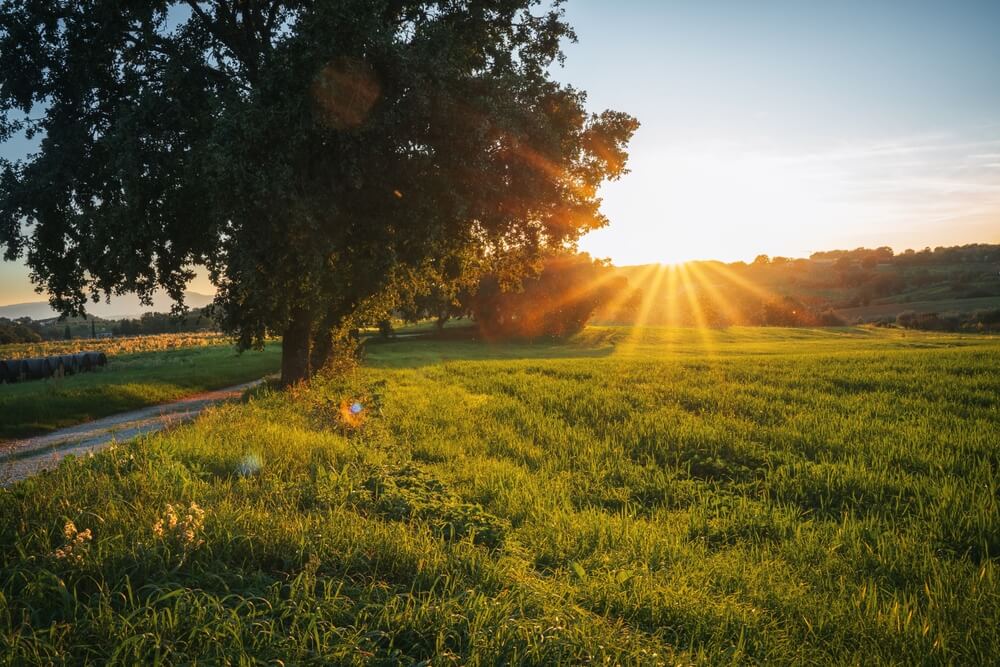
We also love Umbria in the Summer. Those enjoying a villa holiday in Umbria in the Summer will be rewarded with plenty of beautiful sunny days. If you want to enjoy time relaxing poolside at your Umbria villa, visit in July and August. Average high daily temperatures in this month sit at 29°C. These are the busiest months for holidaymakers but, even when numbers are at their peak, Umbria’s towns and villages never seem to experience the crowds of tourists that neighbouring Tuscany does. These are also great months for music lovers to enjoy a holiday in Umbria, since Umbria Jazz and Trasimeno Blues both take place at this time.
Don’t rule out visiting Umbria in the Winter either. You will find some hotels and restaurants closed in Umbria’s tourist hotspots. But there will still be plenty open and it’s an opportunity to experience the region at its most authentic. Choose the location for your Umbria villa holiday carefully. Opt to stay in Spello, for example, and you will find the majority of restaurants stay open. In fact, it’s a great time to try the year’s new olive oil and to sample the truffles.
January is the coldest month, with daily highs averaging just 9°C. Temperatures in February are similar but typically there is less rainfall than in January when you should be prepared for rain on 50 per cent of days. If you don’t mind wrapping up warm, this is certainly the time to explore Umbria without the crowds. You can expect major sites such as the Basilica in Assisi (or Umbria’s six other UNESCO World Heritage sites) to be relatively deserted. And at the end of February, the black truffle season kicks off in Umbria with the Nero di Norcia.
How many days do you need in Umbria?
Whilst Piedmont is the birthplace of slow travel, Umbria could just as easily hold that crown. With visitors traditionally coming to the region as part of the camino, to rush through Umbria feels like a bit of a travesty. However, we understand that in the modern world our trips sometimes have to be limited to a few days so we have come up with some Umbria itineraries to suit all different lengths of trips.
We think every Umbria Itinerary should include Assisi. Even travellers with no religious affiliation will feel the strong sense of spirituality which runs deep through Assisi’s heart. We also think a trip to Umbria must also include at least one day (and a night really) in Spello. While Spello has less official religious history than Assisi, over the years we have definitely built a connection with Spello and often rate it as one of our favourite towns in Italy.
At Bookings For You, we’ll happily help create a bespoke itinerary for your Umbria villa holiday. After all, an itinerary will vary dependent on the location of your villa in Umbria and whether this is your first visit or whether you’re returning seasoned holidaymakers.
3 Days in Umbria
Umbria lends itself quite well to a mini-break. As one of Italy’s smallest regions, hopping between some of its stunning hilltop towns is easily done in just a few days. Ideally you would fly into Perugia and spend your first morning here. Spend your time wandering through the historic centre, taking in the Fontana Maggiore, Piazza IV Novembre and the impressive Rocca Paolina. If you enjoy museums, the National Gallery of Umbria is well worth a visit.
We then recommend making Spello your base for spending 3 days in Umbria. By opting to stay in a villa or apartment in Spello itself, not only will you be in one of Italy’s prettiest hilltop villages but you will also be perfectly positioned in the region to discover the world-renowned vineyards and majestic countryside.
After a day discovering Spello’s magic, our advice is to take the train over to Assisi – it’s just a 30 minute journey. Alternatively, you can easily cycle between the two. Spend the afternoon wandering the picturesque streets and enjoy the calm as the sun begins to set and Assisi’s many day trippers leave.
While it may be tempting to rush through the region and try to see it all, this is not what we recommend. Umbria is not designed to be hurried. By choosing one corner of the region to explore on an Umbria mini-break, you will enjoy it much more and we have no doubt that you will return to discover more of this stunning region in Italy.
5 Days in Umbria
With five days to enjoy Umbria, you will have enough time to see more of what the region has to offer. Again, ideally you will arrive into Perugia and use the first morning of your trip exploring Umbria’s capital. Basing yourself in Spello is still an excellent choice for a 5 day trip to Umbria. Perfectly positioned between Perugia, Assisi and Spoleto, not only is it very well connected but it’s also the perfect place to return to after some exploring for a relaxing, authentic Umbrian evening. Spello itself is one of the region’s most charming towns, so we recommend allowing time to enjoy it properly.
Assisi will be on any Umbria itinerary and quite rightly so. If you have 5 days in Umbria we recommend spending at least 1 day in Assisi. In the morning, visit the Basilica di San Francesco, one of Italy’s most important religious and artistic sites. Allow time to explore the Upper and Lower Basilicas and then wander through the medieval streets towards Piazza del Comune.
In the afternoon, walk or drive up to the Rocca Maggiore for panoramic views across the Umbrian plain. Return to Spello in the early evening, stopping along the way if the mood takes you for a countryside aperitivo.
Combining a trip to both Spoleto and Trevi is an excellent idea if you are short on time. They are just 12 miles apart. If you can make it to Trevi in the morning, you will see this magical hilltop town in the calm of sunrise and there are some excellent cafes in which to enjoy a morning espresso and cornetto. Then head over to Spoleto – a much larger town – for a day of exploring.
While you may feel that you can fit more in during 5 days in Umbria, once again we would advise against over scheduling your time. Umbria is not meant to rushed.
A week in Umbria
Having the pleasure of a week in Umbria, is long enough to see the region’s main attractions. Again we recommend flying into Perugia (or arriving there by train) and spending your first morning exploring the city. However, with 7 days in Umbria, we would recommend choosing a villa in Umbria with a pool – especially if you’re travelling during the summer months. Not only will this give you a sanctuary to return to after a day of exploring, but it also gives you the option of spending a morning or afternoon relaxing poolside.
In addition to the places listed in the 5 day itinerary above, we also recommend the addition of a day in Gubbio – especially if you’re staying in the north of the region or or a trip to the magnificent Lake Trasimeno. However, if you’re based further south, consider Orvieto. Both sit close to the border with Tuscany so it’s also a viable option to head over to Tuscany to do some exploring there too.
With 7 days in Umbria, you must also make time for a wine tasting at one for the region’s highly acclaimed vineyards. Most hosts also offer a light tasting menu to enjoy alongside the wines. Umbria’s wine makers are incredibly knowledgeable, with vineyards often having been passed down in families from generation to generation.
10 Days in Umbria
10 days in Umbria is ample time to explore the region without feeling rushed. We recommend factoring at least a day or two to sit back and relax at your villa in Umbria. Why not take relaxing to the next level and let us arrange for a private chef to come and take over the cooking duties? Or enjoy a wine tasting in the comfort of your own private villa. With 10 days in Umbria, you can enjoy everything on the 5 and 7 day itineraries but also make an extended trip to one of the region’s stunning towns or spend a full day in the Monti Sibillini National Park.
If you are based near the Tuscan border it’s also an opportunity to discover another Italian region. Likewise, if your base is in the south of Umbria, the journey to Rome by train from Terni is only just over 1 hour. Umbria’s central location in Italy really does lend itself to the ease of seeing yet more of our favourite country in the world.
14 Days in Umbria
With 14 days to enjoy in Umbria, we would recommend either choosing two bases or opting for a villa in Umbria with a central location. Choosing one base near to Spello is a good idea so you can experience Spello’s beauty and charm first hand and also take advantage of the good transport links by both rail and road to the surrounding countryside and nearby towns.
For a second base, we would either recommend opting to stay in a villa in the magnificent Umbrian countryside and enjoy some time immersed in nature or head to Orvieto to experience a very different Umbrian town with easy reach over the border to Tuscany. This will also give you a chance to explore the south of the region too. Again though, try to resist the temptation to see it all. Rushing through a list of the top ten places to visit in Umbria is no way to really enjoy the region. Try to plan logical day trips as we’ve suggested above where you may visit one or two towns or attractions in one day leaving you plenty of time to relax too.
A Month in Umbria
The privilege of a month in Umbria allows you to completely immerse yourself in Umbrian life. Of course, you’ll want to visit the region’s famous towns and cities, but don’t rush. Spend mornings shopping at local markets, getting to know seasonal produce and prepare simple meals at your Umbria villa using olive oil from nearby groves.
Each town and village will have a weekly market. In Perugia, the Mercato Coperto is worth visiting. Situated just off the Piazza Matteotti, the permanent food market is a great place to stock up on supplies! Terni also has a permanent daily market. In Assisi, you’ll find a market every Monday morning, in Gubbio it’s on a Tuesday and on Thursday you’ll find markets in both Orvieto and Citta di Castello. Orvieto also has a market on a Saturday too whilst on Sunday you’ll find one in Spoleto.
Later in the day, get into the rhythm of Umbrian life and join the locals for a daily passeggiata and enjoy an aperitivo in a neighbourhood bar where you’ll quickly become a familiar face.
Over the course of a month, you can explore Umbria’s towns and villages in more depth than an average tourist. Take time to get to know the towns and cities – try to return more than once to each. Rather than ticking off sights, slow down and enjoy the rhythm of each town. Choose to visit museums one day, attend a festival another, or simply sit in a piazza and observe daily life. With time on your side, even the smallest villages reveal their charm. In fact these are often the most charming places in Umbria.
A month in Umbria allows for balance. Try to alternate sightseeing days with quieter ones spent at your Umbria villa, reading, swimming or simply enjoying the view. At Bookings For You, we would be delighted to help create a bespoke itinerary for your month long Umbrian escape. Whether you’re visiting for the first time or returning to a region you already love, we can tailor recommendations around the location of your Umbria villa and your personal interests, helping you make the most of this truly special experience.
Umbria holidays for...
Umbria is incredibly diverse. With stunning countryside and some of the most magical hilltop towns in Italy, it ticks so many boxes that a holiday in Umbria can have a very broad appeal. Making it easy for us to put together some great ideas about the best Umbria holidays for different travellers.
For Couples
We think Umbria is one of Italy’s most romantic regions, even if it often flies under the radar when compared to more popular destinations such as Tuscany or the Amalfi Coast. However this is exactly what we think makes it perfect for a romantic retreat. For many couples, Umbria’s appeal lies in its quiet beauty and timeless towns. Umbria is authentic and perfect for couples seeking a romantic escape that feels unhurried and intimate. And, don’t forget that Umbria was the birthplace of Saint Valentine!
Stroll hand in hand through Spello’s ancient lanes, where flower-filled balconies, stone archways and sweeping countryside views create the perfect backdrop for romance. Be sure to enjoy long lunches in sun-drenched piazzas, lingering over local wine and delicious Umbrian specialities. At Bookings For You we have some beautiful apartments in Umbria perfect for couples to retreat to after a day of discovering this magical region.
For Families
Umbria should be high on your list if you’re travelling to Italy as a family, particularly during European school holidays. Often overshadowed by Tuscany, the region remains far less crowded and refreshingly authentic, making it an ideal destination for families seeking space, value and a slower pace of travel. With fewer tourist traps and a strong sense of local life, Umbria offers children and adults alike the chance to experience ‘real Italy’.
The region’s variety makes it especially well suited to family travel. Explore medieval hill towns or enjoy easy walks around Lake Trasimeno. Be sure to spend some time outdoors cycling, hiking or picnicking in the beautiful countryside. There are also plenty of hands-on experiences to enjoy together, from cooking classes to boat trips and festivals in small villages. Family is at the heart of every experience in Umbria. But make sure you save some time to relax and reconnect at your Umbria villa – the perfect place to make memories to last a lifetime.
Solo Travellers
As one of Italy’s spiritual heartlands, Umbria is very popular with pilgrims making their way to Assisi. As a result, there are many solo travellers in the region and it’s perfectly set up for those looking to discover Umbria alone. However, not every solo traveller in the region is a pilgrim and there are some amazing experiences which you can join to meet like-minded people. From cooking classes to wine tastings and guided walks – there is something for everyone. But, equally Umbria can be the perfect place to come to for solitude. The countryside can be majestically silent – peace and quiet perfection.
For Groups
With something for everyone, Umbria is perfect for a multi-generation holiday or for larger groups of friends looking for an authentic Italian holiday.
Renting a villa in Umbria in the heart of the countryside is a great option for gatherings of friends or extended families. You’ll be able to enjoy the privacy and space that a self-catering villa offers whilst enjoying the wealth of cultural attractions that Umbria has to offer. Villas in Umbria with pools and expansive gardens are the perfect setting for a memorable group stay. Plus, they tend to offer much better value for money than Umbria’s more famous neighbour, Tuscany. We recommend hiring a private chef to cook for you so that everyone can put their feet up and relax.